

Countronics
Categories: Humidity Meter
Humidity is water in vapour form mixed with air. You cannot see it, but it affects how materials behave, how products store, how people feel and whether surfaces sweat. Air at any temperature can hold only a limited amount of vapour. That limit rises steeply with temperature, and it is why the same air can feel damp in the morning and dry in the afternoon.
| Term | What it means | Unit | Changes with temperature? | Best used for |
|---|---|---|---|---|
| Relative humidity (RH) | Actual vapour as a % of the maximum possible at that temperature | % RH | Yes | Comfort, storage, hygroscopic materials |
| Dew point | Temperature at which the air becomes saturated | °C | No (only changes if moisture changes) | Condensation, compressed air, drying |
| Absolute humidity | Mass of water vapour per volume of air | g/m³ | Slightly (air expands) | Load calculations, drying processes |
| Mixing ratio / humidity ratio | Mass of vapour per mass of dry air | g/kg | No | HVAC and psychrometric design |
| Wet-bulb temperature | Temperature of a wetted thermometer cooled by evaporation | °C | Yes | Cooling towers, heat stress |
The maximum amount of vapour air can hold is set by the saturation vapour pressure, which roughly doubles for every 10–11 °C rise.
| Air temperature | Saturation vapour pressure |
|---|---|
| 15 °C | 17.0 hPa |
| 20 °C | 23.3 hPa |
| 25 °C | 31.6 hPa |
| 30 °C | 42.3 hPa |
| 35 °C | 56.1 hPa |
RH = actual vapour pressure ÷ saturation vapour pressure × 100.
Worked example: a store room is at 20 °C and 60 % RH. The actual vapour pressure is 0.60 × 23.3 = 14.0 hPa.
No water was added or removed, yet RH ranged from 33 % to 82 %. Near room temperature, a 1 °C change shifts RH by roughly 3 % RH at mid-range humidity. This is why a humidity reading always needs a temperature reading next to it.
Dew point is the temperature to which air must be cooled, without changing its moisture, for it to reach 100 % RH. Any surface colder than the dew point collects condensation.
A widely used approximation is the Magnus formula:
γ = ln(RH/100) + (17.62 × T) ÷ (243.12 + T)
Dew point = 243.12 × γ ÷ (17.62 − γ), with T in °C.
Worked example: a warehouse at 30 °C and 70 % RH.
γ = ln(0.70) + (17.62 × 30) ÷ 273.12 = −0.357 + 1.935 = 1.578
Dew point = 243.12 × 1.578 ÷ (17.62 − 1.578) = about 23.9 °C.
So any pipe, wall or product below about 24 °C in that warehouse will sweat. Cartons brought out of a cold room at 18 °C will collect moisture until they warm up.
| Air condition | Approximate dew point |
|---|---|
| 22 °C, 50 % RH (office) | 11 °C |
| 25 °C, 60 % RH | 17 °C |
| 30 °C, 70 % RH (monsoon warehouse) | 24 °C |
| 35 °C, 80 % RH (humid coastal day) | 31 °C |
Absolute humidity is the actual mass of water vapour in a cubic metre of air:
Absolute humidity (g/m³) ≈ 216.7 × e ÷ (T + 273.15), where e is the actual vapour pressure in hPa.
For 30 °C and 70 % RH, e = 0.70 × 42.3 = 29.6 hPa, so absolute humidity ≈ 216.7 × 29.6 ÷ 303.15 ≈ 21 g/m³. A 1,000 m³ room at that condition holds about 21 litres of water as vapour. This kind of number is useful when sizing a dehumidifier or a drying process.
| Question you are asking | Use |
|---|---|
| Will paper, textiles, wood, powders or tablets absorb moisture? | RH at the material’s temperature |
| Will condensation form on pipes, walls or products? | Dew point vs surface temperature |
| Is the compressed air dry enough? | Pressure dew point |
| How much water must a dehumidifier remove? | Absolute humidity or humidity ratio |
| Are people comfortable? | RH together with temperature |
Next, see how storage limits are set in warehouse temperature and humidity monitoring, how tight limits work in clean rooms, and how continuous records are kept with temperature and humidity data loggers.
Relative humidity is how full the air is with water vapour compared with the maximum it can hold at that temperature, in percent. Dew point is the temperature at which that air would become saturated and start to condense. RH changes when temperature changes; dew point does not, unless moisture is added or removed.
Warm air can hold more water vapour. Heating does not remove any moisture, but it raises the maximum the air can hold, so the same amount of vapour becomes a smaller percentage. Air at 20 °C and 60 % RH heated to 30 °C drops to about 33 % RH.
Most people are comfortable between about 40 % and 60 % RH. Below 30 % skin and eyes feel dry and static increases. Above 60 % air feels sticky and mould and dust mites become more likely.
Use dew point. Condensation forms on any surface colder than the dew point of the surrounding air. Compare the dew point with the coldest surface temperature, such as a cold pipe, wall or product.
No. 100 % RH means the air is saturated at its current temperature. Fog, dew or condensation can then form, but rain needs cloud processes higher in the atmosphere.
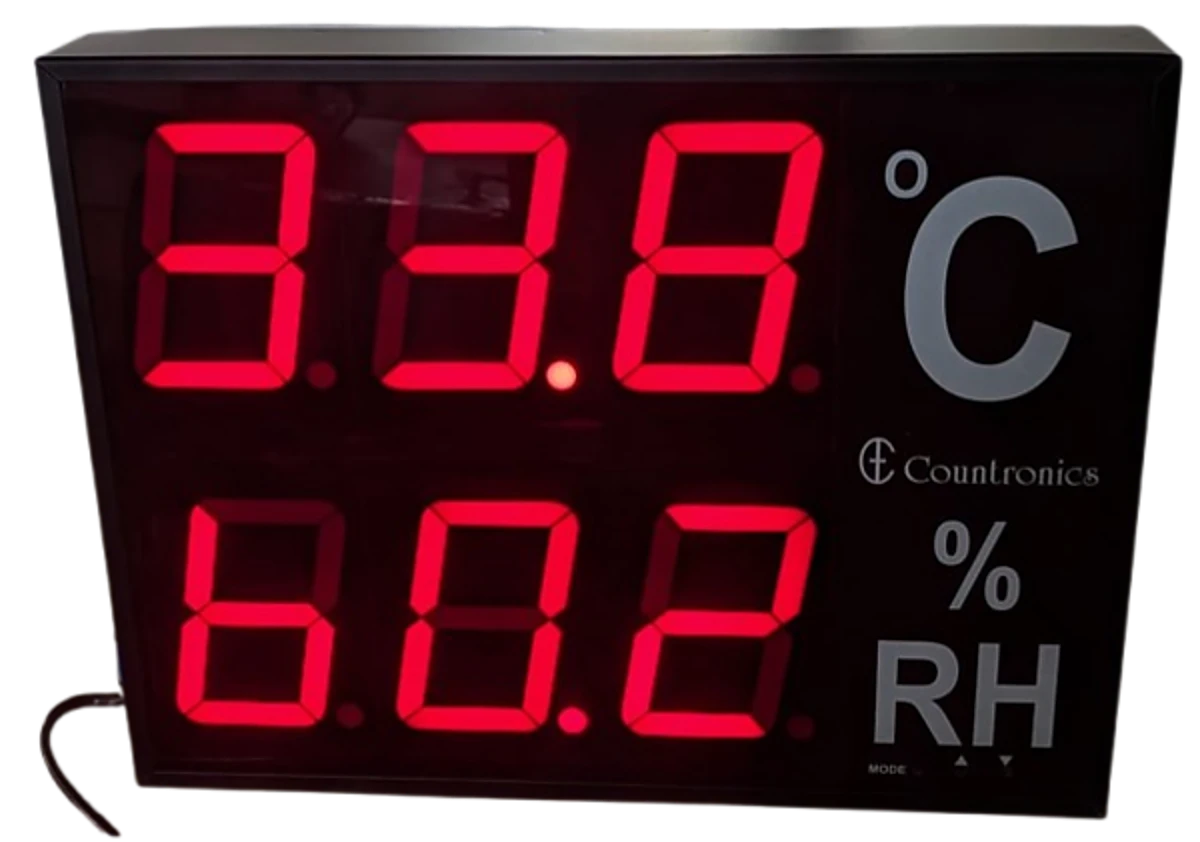
Countronics makes temperature and humidity indicators and controllers that display RH and temperature together, with relay outputs for control and alarms. Tell us where you need to measure and we will suggest a suitable model.
By Countronics

By Countronics

By Countronics

© 2026 - countronics.com
WhatsApp us