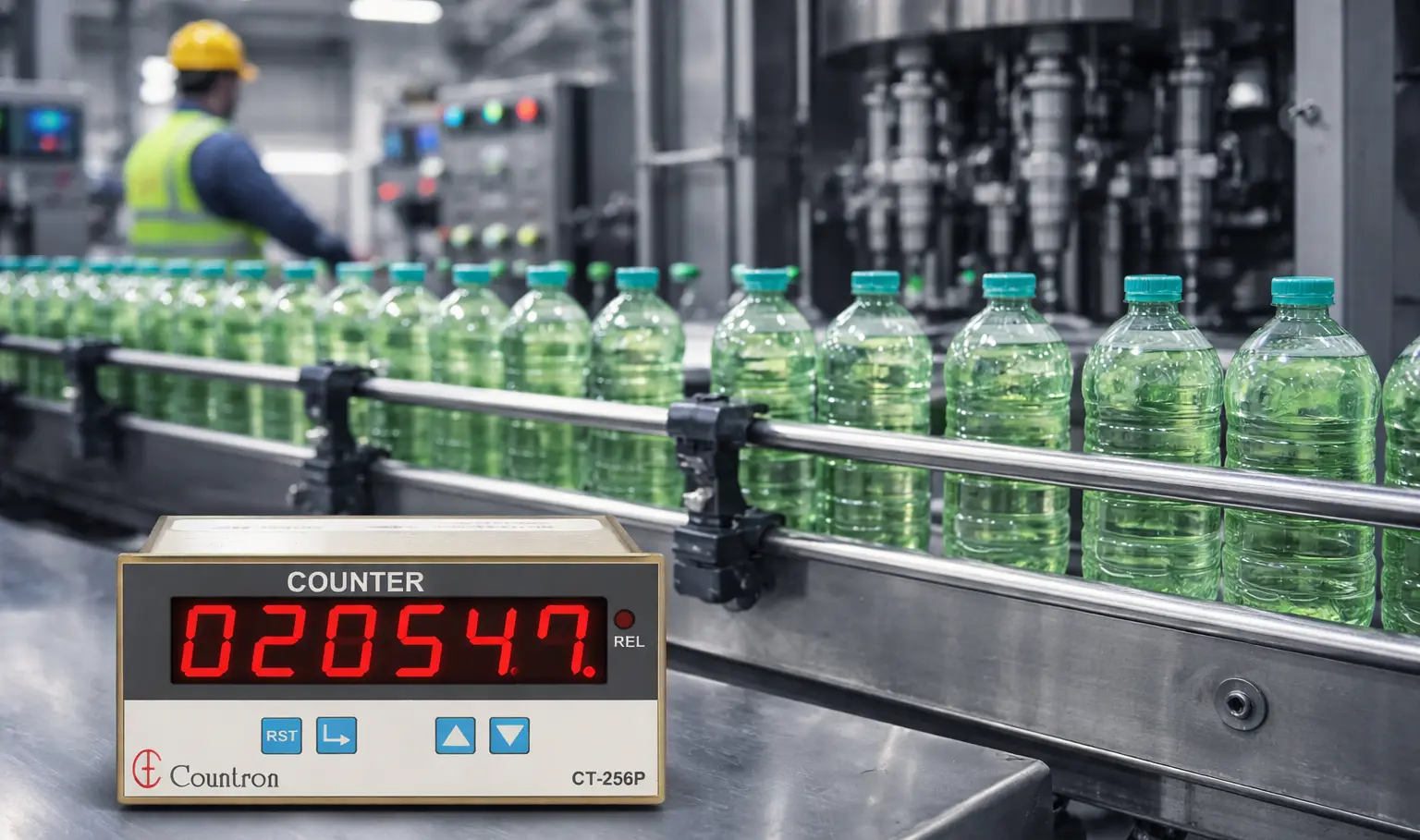

Digital Counter Make Counting Convenient and Easy

How To Choose An Industrial Digital Counter: Preset vs Totaliser, Input Sensors, Count Speed And Relay Outputs

In short: Use a totalising (event) counter when you only need to know how many; use a preset counter when a relay must act at a target count — cutting, batching, stopping a machine. Then match the input (proximity, photo sensor, limit switch), the count speed, the number of set limits and the reset method.

Totalising Counter or Preset Counter?

TypeWhat it doesTypical use
Totalising / event counterCounts and displays; no control outputProduction records, machine strokes, footfall
Single preset counterRelay operates at one target countBatch packing, coil winding, cut-to-count
Two-set-limit counterPre-warning relay plus final relaySlow-down before stop, two-stage filling
Dual-display counterShows set value and actual count togetherOperator-friendly batching

Countronics examples: the 246 event counter, the 256P single preset counter, the 2500 counter with two set limits and the 254D dual-display counter.

Which Sensor Should Feed the Counter?

  • Inductive proximity sensor – counts metal targets such as gear teeth, bolts or cams; unaffected by dust and oil.
  • Photo (optical) sensor – counts cartons, bottles and bags on conveyors; needs a clean lens and proper alignment.
  • Limit switch / reed switch – simple and cheap, but mechanical contacts bounce, so the counter needs a low-speed (debounce) input.
  • Encoder or pulse transmitter – for length counting, with scaling to metres.

Count Speed: Why It Matters

Every counter has a maximum input frequency. Mechanical contacts may only be reliable at a few counts per second, while electronic sensors can be counted far faster. If pulses arrive faster than the counter can read them, counts are silently lost. Work out the peak rate: a conveyor carrying 6 cartons per second needs at least 6 Hz, plus margin.

Scaling: Counting Metres, Not Pulses

For cable, wire, fabric or paper, the counter reads pulses from a wheel or encoder and multiplies by a scale factor. Example: a 0.2 m circumference wheel with 10 pulses per turn gives 0.02 m per pulse — set the scale factor to 0.02 and the display reads directly in metres.

Reset and Memory

  • Front-panel reset for operator control.
  • Remote reset input so a PLC or foot switch can restart the batch.
  • Auto-reset at the preset value for continuous batching.
  • Power-failure memory so the count is not lost when power trips.

Mistakes to Avoid

  1. Using a mechanical switch at a speed it cannot follow.
  2. Photo sensor mounted where two products can pass as one.
  3. No pre-warning output, so the machine overshoots the target count.
  4. Sensor cable run next to motor power cables, causing false counts.

Quick Checklist

  • Totalise only, or act at a preset count?
  • Sensor type and supply
  • Peak count rate
  • Number of set limits
  • Scaling needed?
  • Reset method and memory
  • Panel size and supply voltage (230 V AC, 110 V AC or 24 V DC)

Frequently Asked Questions

What is the difference between a preset counter and a totaliser?

A totaliser only counts and displays. A preset counter also operates a relay when the count reaches a value you set, so it can stop a machine, cut material or end a batch.

Why is my counter missing counts?

Common causes are pulses faster than the counter’s input rating, contact bounce from mechanical switches, a dirty or misaligned photo sensor, or electrical noise from nearby motor cables.

Can a digital counter measure length?

Yes. Feed it pulses from a measuring wheel or encoder and set a scale factor, and it displays length in metres directly.

Will the count be lost after a power cut?

Not if the counter has power-failure memory, which stores the count and resumes from the same value when power returns.

Which sensor should I use for counting bottles or cartons?

A photo (optical) sensor is usual for non-metal products on a conveyor. Inductive proximity sensors suit metal targets.

Need a Counter for Your Line?

Countronics makes event counters and programmable preset counters with single or dual set limits. Tell us what you count, the speed and the sensor, and we will recommend a model.


In short: A contact tachometer touches the shaft centre or uses a wheel on a surface — good for checking RPM and line speed. A non-contact (photo) tachometer reads reflective tape from a
Contact vs Non-Contact vs Panel Tachometers: How RPM Is Measured And Which One To Choose
In short: An on-delay timer switches once after a set time; a cyclic timer repeats ON/OFF periods continuously; a sequential timer switches several outputs one after another; a programmable digital timer lets you
Industrial Timer Types Explained: On-Delay, Cyclic, Sequential And Programmable Timers
In short: Use a totalising (event) counter when you only need to know how many; use a preset counter when a relay must act at a target count — cutting, batching, stopping a
How To Choose An Industrial Digital Counter: Preset vs Totaliser, Input Sensors, Count Speed And Relay Outputs