

Countronics
Categories: PH Controller
| Mode | How it works | Use when |
|---|---|---|
| On/off | Pump runs fully until pH reaches set point | Large tanks, slow processes, buffered water |
| Pulse / proportional | Pump runs in short pulses that shrink as pH nears set point | Small tanks, inline dosing, weakly buffered water |
| Cause | Fix |
|---|---|
| Pump too large | Smaller pump, dilute chemical, or pulse dosing |
| Poor mixing | Add a mixer; dose at the inlet of the mixing zone |
| Electrode too far from dosing point | Reduce dead time; place probe after mixing |
| No dosing delay | Set a pause so the reaction can complete |
| Hysteresis too small | Widen the band to stop hunting |
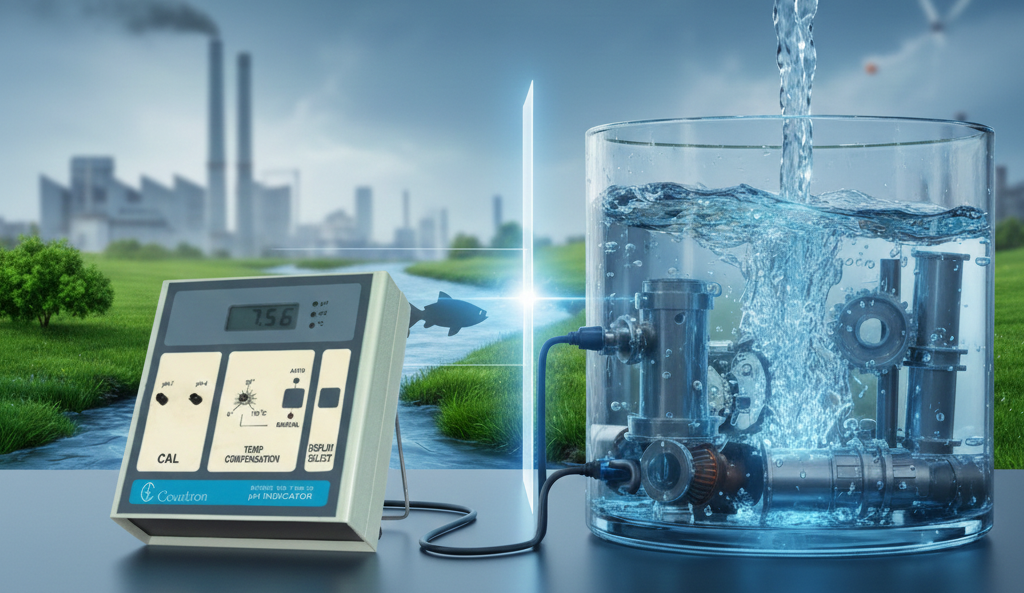
Countronics pH controllers such as the 112pH and 110pH offer two set limits and 4–20 mA outputs — see pH and ORP controllers. For background, see what is a pH controller.
Usually because the dosing pump is too large for the demand, mixing is poor, or the electrode is too far from or too close to the dosing point. Pulse dosing and a dosing delay help.
On/off suits large, buffered tanks. Pulse or proportional dosing is better for small tanks and inline dosing.
Downstream of the mixing zone, where the water is well mixed but not so far that the reading lags badly.
A pause after each dose so the chemical can react before the controller decides to dose again.
Yes, with two relays — one for each pump — and an interlock so both never run together.
Countronics makes pH controllers with dual limits and 4–20 mA outputs for dosing pumps. Share your tank size, flow and chemical and we will suggest settings.
By Countronics
By Countronics
By Countronics
© 2026 - countronics.com
WhatsApp us