

Countronics
Categories: Conductivity Meter
Water may look clean, yet carry dissolved salts, minerals, and industrial chemicals invisible to the naked eye. These dissolved solids silently degrade water quality, damage industrial equipment, and endanger human health. Among all the parameters used to assess water purity, conductivity and TDS (Total Dissolved Solids) are the most reliable and widely measured — giving a clear, instantaneous picture of how pure or contaminated the water truly is.
What Are Conductivity & TDS and How Are They Measured?
Conductivity is the ability of water to conduct electrical current, determined by the presence of dissolved ionic substances such as salts, acids, and alkalis. TDS represents the total concentration of all dissolved solids in water, expressed in mg/L or ppm. The two are directly related — higher dissolved solids mean higher conductivity.
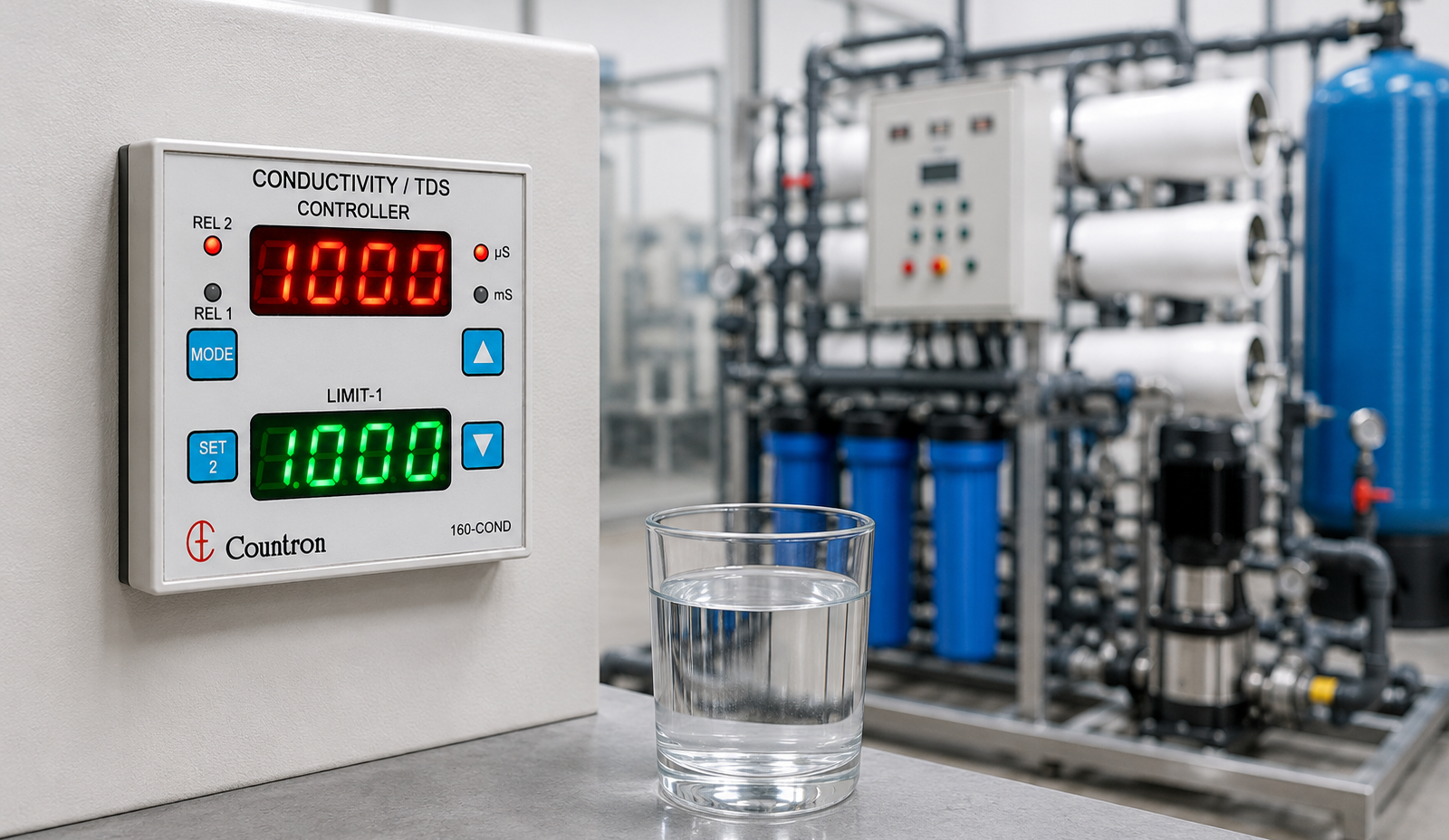
A conductivity sensor consists of two or four electrodes immersed in the water stream. It applies an alternating voltage across the electrodes and measures the resulting current. The ratio gives the conductivity value in µS/cm or mS/cm, which a conductivity/TDS controller converts into a readable display and uses to trigger solenoid valves, dosing pumps, or alarms automatically.
Why Conductivity & TDS Matter in Water Purification
Every water purification system — whether a Reverse Osmosis (RO) plant, Demineralisation (DM) plant, or ion exchange unit — depends on conductivity monitoring to confirm purification effectiveness. A rising TDS reading at the output of an RO membrane is the first signal that the membrane is failing or fouling. Without continuous monitoring, contaminated water passes undetected into the downstream process, causing costly damage and compliance failures.
Industrial Water Treatment Applications
Industries such as power plants, pharmaceuticals, food & beverage, boiler feed water systems, and semiconductor manufacturing demand water within extremely tight conductivity limits. In boiler feed water, even slightly elevated TDS causes scale deposition, reducing heat transfer efficiency and risking catastrophic boiler failure. A conductivity controller continuously monitors the feed water and automatically triggers blowdown valves when TDS exceeds the set limit, protecting the system without manual intervention. In pharmaceutical and food processing, regulatory standards mandate ultrapure water with conductivity below 1 µS/cm. A conductivity controller with high and low set-point alarms ensures the purification system operates within validated limits at all times.
RO & DM Plant Monitoring
In RO plants, conductivity measurement at both inlet and outlet allows real-time calculation of salt rejection percentage — the most critical performance indicator of the membrane. In DM plants, the controller monitors resin exhaustion and triggers regeneration cycles automatically, optimising chemical consumption and plant uptime.
Conclusion
As water quality standards tighten across industries, conductivity and TDS monitoring is no longer optional — it is the backbone of every reliable water purification system. At Countronics, we manufacture precision conductivity and TDS indicators and controllers built for demanding industrial environments, delivering accurate, continuous, and automated water quality management.
Explore our Conductivity / TDS Indicators and Controllers range at www.countronics.com
By Countronics

By Countronics

By Countronics

© 2026 - Home Automation WordPress Theme. countronics.com
WhatsApp us