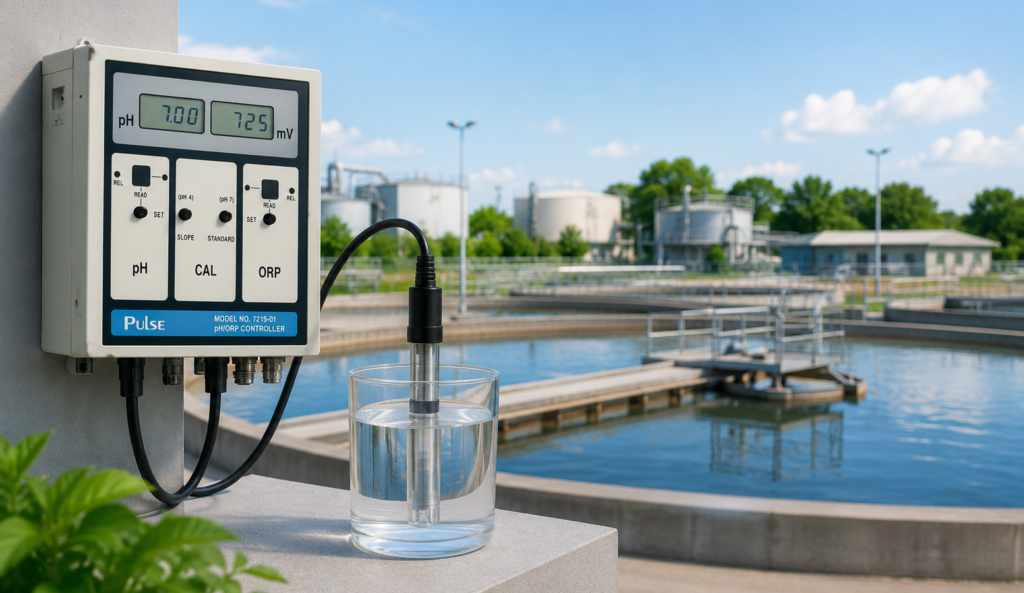

Water, the very foundation of life, industry, and agriculture, is under constant threat from pollutants discharged into it every single day. From factory effluents to municipal sewage, the invisible chemical imbalance in our water bodies is far more dangerous than what meets the eye. Among all the parameters that define water health, pH stands at the forefront — a single number that tells the entire story of water quality.
What Is pH and How Is It Measured?
pH is a scale from 0 to 14 that measures the concentration of hydrogen ions in a solution. A value of 7 is neutral, below 7 is acidic, and above 7 is alkaline. A pH sensor — typically a glass electrode — is immersed directly into the water stream. It generates a millivolt (mV) voltage signal proportional to the hydrogen ion concentration, which a pH controller converts into a readable 0–14 value and uses to trigger dosing pumps or raise alarms automatically.
Why pH Matters in Water Treatment
Every treatment process — coagulation, flocculation, disinfection, or biological treatment — operates effectively only within a specific pH range. Chlorine disinfection is most effective between pH 6.5 and 7.5. Beyond this window, the disinfectant loses potency and harmful microorganisms survive. In biological treatment, a sudden spike in acidity or alkalinity kills the microbial population and collapses the entire treatment stage.
Industrial Effluent Treatment
Industries such as textiles, pharmaceuticals, electroplating, and paper mills generate highly acidic or alkaline effluent. Discharging such water into rivers without neutralization is both an environmental crime and a public health catastrophe. India’s pollution control boards mandate strict pH limits — typically between 6.5 and 8.5 — for industrial discharge. A pH controller continuously monitors incoming effluent and automatically doses the required acid or alkali, eliminating dependency on manual sampling and delivering compliant effluent management around the clock.
Agricultural and Aquaculture Applications
Highly acidic or alkaline irrigation water alters soil pH over time, locking essential nutrients away from the root zone and reducing crop yield. With a pH controller at the irrigation inlet, farmers can protect soil health and harvest quality. In aquaculture, even a small pH deviation causes stress, disease, and mass mortality in fish and shrimp. A pH controller installed in tank or pond systems continuously regulates water chemistry, ensuring a stable environment for healthy growth.
Conclusion
As industries grow and environmental regulations tighten, reliable pH control is not merely a technical upgrade — it is a commitment to responsible water management. At Countronics, we manufacture precision pH controllers built for industrial water treatment and process monitoring. Protecting water quality is protecting life itself.
Explore our range of pH Indicators, controllers, transmitters and loggers at www.countronics.com
By Countronics

By Countronics

By Countronics

© 2026 - Home Automation WordPress Theme. countronics.com
WhatsApp us
