

Countronics
Categories: Humidity Controller
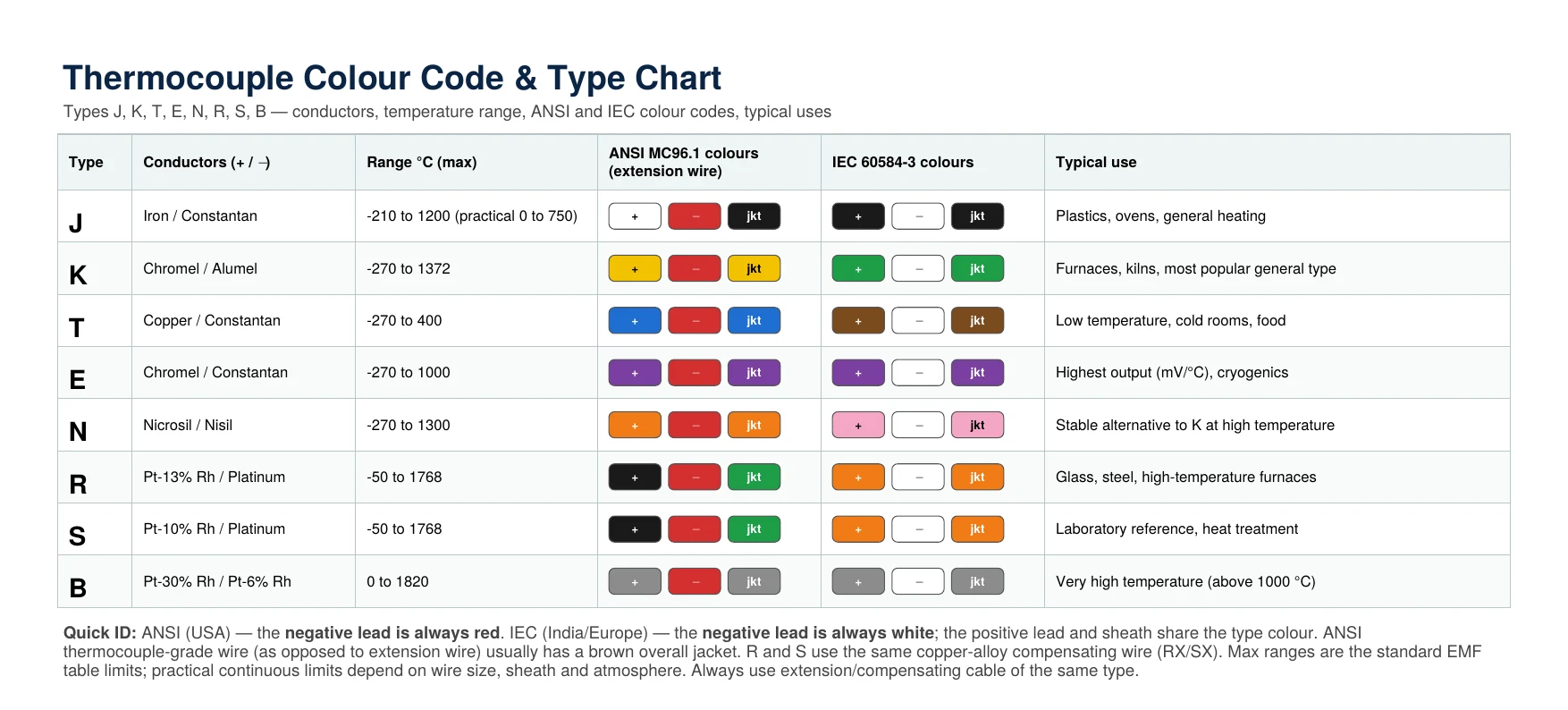
⬇ Download the free Countronics Thermocouple Chart (PDF, 2 pages)
| Type | Conductors (+ / −) | Range (°C) | IEC colour (+ / −) | ANSI colour (+ / −) | Typical use |
|---|---|---|---|---|---|
| J | Iron / Constantan | −210 to 1200 (practical 0–750) | Black / White | White / Red | Plastics machinery, ovens |
| K | Chromel / Alumel | −270 to 1372 | Green / White | Yellow / Red | Furnaces, kilns — most common type |
| T | Copper / Constantan | −270 to 400 | Brown / White | Blue / Red | Cold rooms, food, low temperature |
| E | Chromel / Constantan | −270 to 1000 | Violet / White | Purple / Red | Highest output per °C, cryogenics |
| N | Nicrosil / Nisil | −270 to 1300 | Pink / White | Orange / Red | Stable alternative to K at high temperature |
| R | Pt-13% Rh / Pt | −50 to 1768 | Orange / White | Black / Red (ext.) | Glass, steel, high-temperature furnaces |
| S | Pt-10% Rh / Pt | −50 to 1768 | Orange / White | Black / Red (ext.) | Lab reference, heat treatment |
| B | Pt-30% Rh / Pt-6% Rh | 0 to 1820 | Grey / White | Grey / Red | Very high temperature, above 1000 °C |
Ranges are the limits of the standard reference tables. The practical continuous limit depends on wire size, sheath material and atmosphere — a thin bare K wire will not last long at 1250 °C, while a heavy mineral-insulated K probe can.
For a deeper comparison, read types of thermocouples.
| Type | ASTM E230 standard | ASTM E230 special | IEC Class 1 | IEC Class 2 |
|---|---|---|---|---|
| J | ±2.2 °C or ±0.75% | ±1.1 °C or ±0.4% | ±1.5 °C or ±0.4% | ±2.5 °C or ±0.75% |
| K / N | ±2.2 °C or ±0.75% | ±1.1 °C or ±0.4% | ±1.5 °C or ±0.4% | ±2.5 °C or ±0.75% |
| T | ±1.0 °C or ±0.75% | ±0.5 °C or ±0.4% | ±0.5 °C or ±0.4% | ±1.0 °C or ±0.75% |
| E | ±1.7 °C or ±0.5% | ±1.0 °C or ±0.4% | ±1.5 °C or ±0.4% | ±2.5 °C or ±0.75% |
| R / S | ±1.5 °C or ±0.25% | ±0.6 °C or ±0.1% | ±1.0 °C (to 1100 °C) | ±1.5 °C or ±0.25% |
Above 0 °C, the larger of the two values applies; percentages are of the measured temperature in °C. Example: a standard-grade K thermocouple at 800 °C may be off by up to ±6 °C (0.75% of 800). Full temperature bands are in the PDF chart.
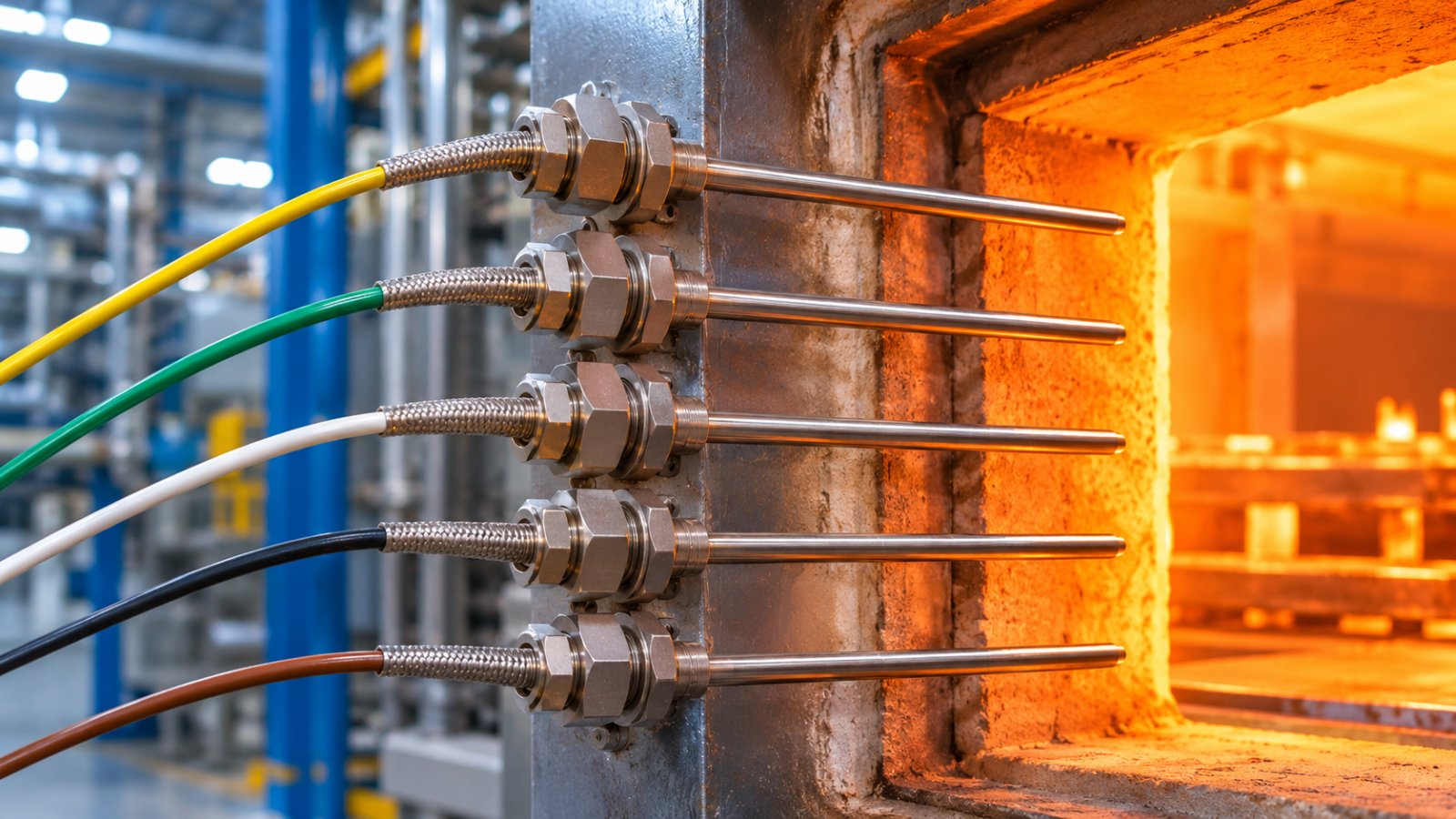
A thermocouple measures the temperature difference between its hot junction and the point where it connects to copper wiring. Extending it with ordinary copper cable moves that cold junction to the wrong place and adds errors. Always use extension or compensating cable of the same type and colour code, and keep polarity correct — a reversed pair reads lower or even negative as temperature rises.
Countronics temperature controllers, indicators and multi-channel data loggers accept J, K and R thermocouples (and PT100), with automatic cold-junction compensation. The CT716 logs up to 16 thermocouples straight to a USB pen drive.
In the IEC code used in India and Europe, the K positive lead and sheath are green and the negative is white. In the ANSI (US) code, K is yellow positive and red negative.
Look at the negative lead: red means ANSI, white means IEC.
J (iron/constantan) is used up to about 750 °C and suits plastics and ovens; K (chromel/alumel) covers up to about 1200 °C continuously and is the general-purpose furnace type.
Standard grade is ±2.2 °C or ±0.75% of reading, whichever is greater, above 0 °C; special limits are ±1.1 °C or ±0.4%.
No. Use extension or compensating cable of the same thermocouple type, or the reading will be wrong.
For long-term use above about 1200 °C, platinum types R, S or B are used; Type N is a stable base-metal option up to about 1200 °C.
Countronics makes temperature controllers, indicators and data loggers for J, K and R thermocouples. Tell us your sensor and range.
By Countronics
By Countronics
By Countronics
© 2026 - countronics.com
WhatsApp us