

Countronics
Categories: Humidity Controller
📘 Part of the Temperature Measurement Knowledge Hub — guides on thermocouples, PT100, controllers and data logging.
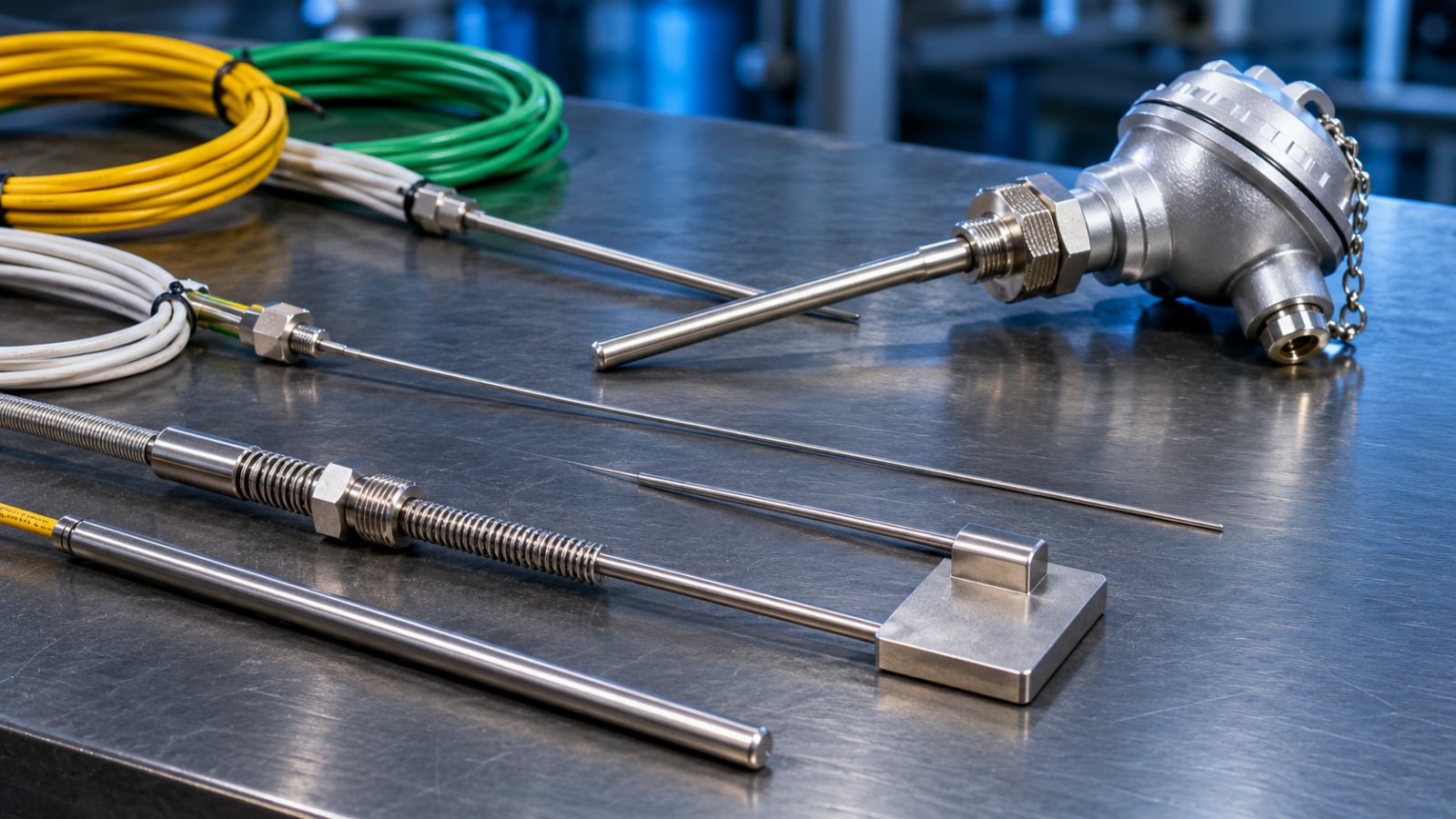
Most industrial probes use mineral-insulated cable: thermocouple wires embedded in compacted magnesium oxide inside a metal sheath. It is robust, bendable, and seals the wires from the atmosphere. Common sheath diameters range from about 1 mm (fast, flexible) to 6–8 mm (rugged).
| Junction | Construction | Response | Pros | Cons |
|---|---|---|---|---|
| Grounded | Welded to sheath tip | Fast | Good heat transfer | Ground loops and noise with some instruments |
| Ungrounded | Isolated inside sheath | Slower (often ~2–3× grounded) | Electrically isolated, best for multi-channel loggers | Slower response |
| Exposed | Bead outside the sheath | Fastest | Ideal for air and gas | No protection from corrosion or damage |
For multi-channel data loggers and scanners, ungrounded junctions avoid channels interfering with each other through the process.
Response is usually quoted as a time constant — the time to reach about 63 % of a step change. Smaller sheath diameter, grounded or exposed junction and fast-moving fluid all speed response. A 6 mm ungrounded probe in still air can take minutes; a 1.5 mm grounded probe in moving water responds in about a second.
| Material | Typical max in air | Notes |
|---|---|---|
| 304 stainless steel | about 900 °C | General purpose |
| 316 stainless steel | about 900 °C | Better corrosion resistance |
| 310 stainless steel | about 1150 °C | Higher temperature |
| Inconel 600 | about 1150 °C | Furnaces; avoid sulphur-bearing atmospheres |
| Ceramic (alumina) | 1600 °C and above | Fragile; for R, S, B types |
Limits depend on atmosphere and duration; check with your sensor supplier. For pressurised pipes and vessels, mount the probe in a thermowell.
A grounded junction is welded to the sheath for fast response; an ungrounded junction is electrically isolated inside the sheath, slower but immune to ground loops.
An exposed junction, followed by grounded, then ungrounded.
Thermocouple wires packed in compacted magnesium oxide inside a metal sheath — rugged, bendable and sealed.
Ungrounded junctions, to avoid ground loops between channels.
Quick-fit, spring-loaded temperature sensing on plastic machinery such as extruders and moulding machines.
Countronics instruments accept J, K, R thermocouples and PT100. See temperature controllers and data loggers, or tell us your process.
By Countronics

By Countronics

By Countronics
© 2026 - countronics.com
WhatsApp us