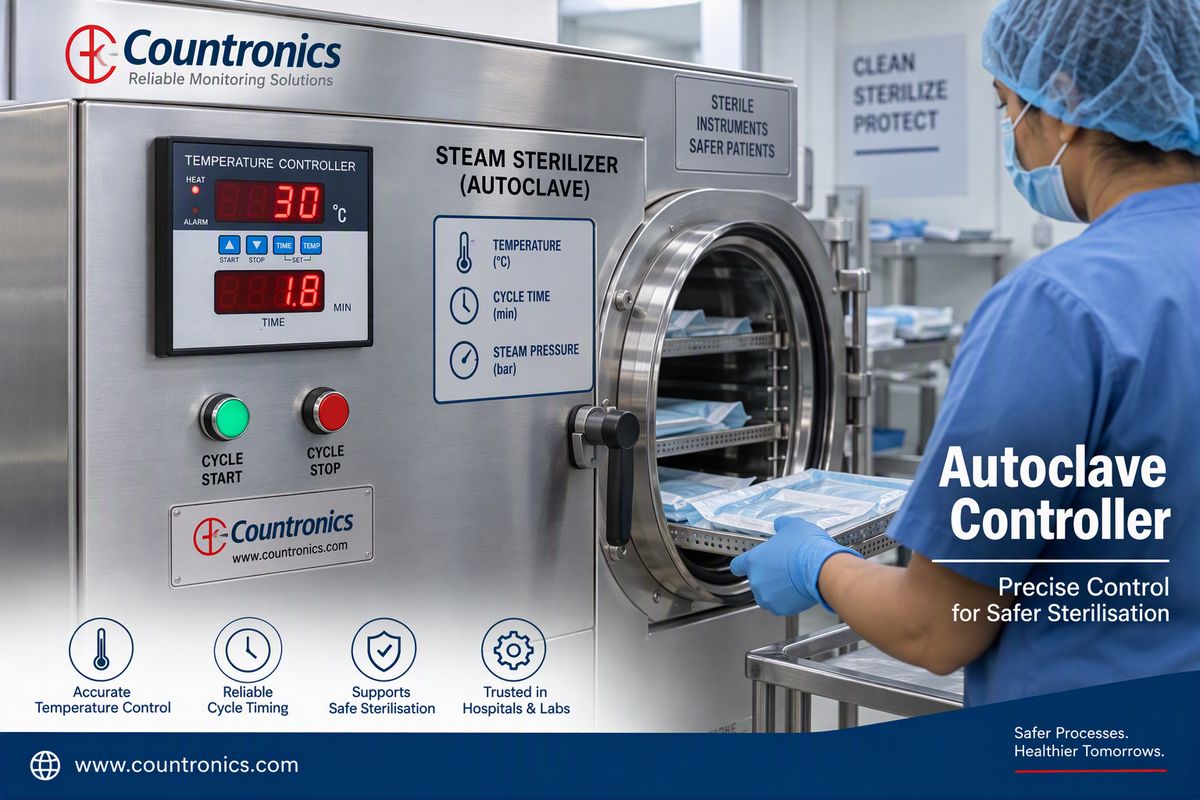

Steam sterilization works by a combination of temperature, time and saturated steam. The two most widely used cycles are:
| Cycle | Temperature | Minimum hold time | Typical use |
|---|---|---|---|
| Gravity / standard | 121 °C (approx. 1.05 bar gauge) | 15 minutes | Media, glassware, unwrapped instruments, lab waste |
| Pre-vacuum / flash | 134 °C (approx. 2.1 bar gauge) | 3–4 minutes | Wrapped instrument packs, hospital CSSD |
These are minimum hold times at temperature. Wrapped packs, dense loads and large volumes of liquid need longer, because the steam takes time to reach the centre. A 1-litre bottle of media, for example, can take well over 20 minutes just to reach 121 °C inside.
Only after the set temperature is reached. If the timer starts when the heater switches on, the heat-up period gets counted as sterilization time. A “20-minute cycle” may give only 8–10 minutes at 121 °C, and even less if the chamber is fully loaded.
Heat-up time also varies with every load. A half-empty chamber reaches temperature faster than a full one. That means a timer started at switch-on gives a different real hold time every cycle, which is exactly what you can’t have in sterilization.
The chamber display can read 121 °C while the centre of the load is still well below it. The usual reasons:
Usually near the chamber drain, at the bottom, where cooler air and condensate collect. That’s why many autoclaves measure temperature at the drain, and why validation probes and biological indicators are placed near the drain and in the centre of the densest pack, not on top.
Three types of checks are used together:
Pre-vacuum autoclaves also need a daily Bowie-Dick test, run in an empty chamber, to confirm air is being removed properly.
The two most widely used steam sterilization cycles are 121 °C held for at least 15 minutes, and 134 °C held for about 3–4 minutes in pre-vacuum autoclaves. Wrapped instruments, large liquid volumes and dense loads usually need longer hold times than these minimums.
The sterilization (hold) time should start only after the chamber, and ideally the load, has reached the set sterilizing temperature. Time spent heating up does not count as sterilization time.
Common causes are timing from switch-on instead of from setpoint, air trapped in the chamber or load, overloading, tightly wrapped packs and liquids that have not reached temperature. The chamber display may show 121 °C while the centre of the load is still cooler.
Usually near the chamber drain at the bottom, where cooler air and condensate collect. This is why temperature sensors and indicators are often placed near the drain or in the centre of the densest pack.
Most facilities use a chemical indicator in every load, a biological indicator at least weekly (and with every load containing implants), and a daily Bowie-Dick air-removal test on pre-vacuum autoclaves. Temperature sensors are usually calibrated at least once a year.
Countronics makes an Autoclave Temperature Controller whose soak timer starts only at setpoint (1–999 min), keeps the cycle status through power cuts, and raises an alarm on heater failure. Talk to us if you want help choosing cycle settings.
By Countronics

By Countronics
By Countronics
© 2026 - Home Automation WordPress Theme. countronics.com
WhatsApp us
