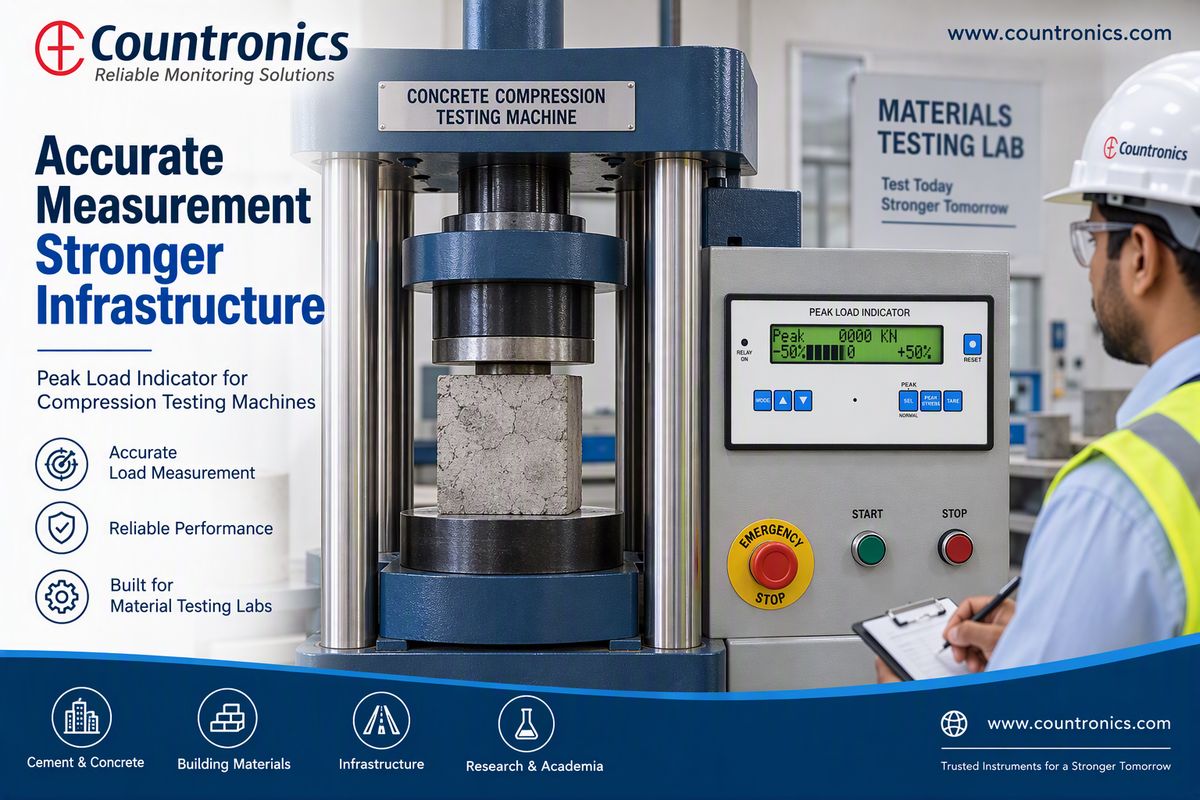

Peak load is the maximum load a specimen carries before it fails. In a concrete cube test it’s the load at which the cube crushes. In a tensile test on steel bars it’s the highest load reached before the bar necks and breaks. Everything that follows (compressive strength, tensile strength, pass or fail) is calculated from this one value.
Compressive strength is the peak load divided by the loaded area:
| Cube size | Loaded area | Peak load | Compressive strength |
|---|---|---|---|
| 150 mm | 22,500 mm² | 450 kN | 20 N/mm² |
| 150 mm | 22,500 mm² | 675 kN | 30 N/mm² |
| 150 mm | 22,500 mm² | 900 kN | 40 N/mm² |
| 100 mm | 10,000 mm² | 300 kN | 30 N/mm² |
Notice how sensitive the result is. On a 150 mm cube, every 22.5 kN of error in the peak reading shifts the result by 1 N/mm², which can be the difference between an M25 batch passing or being questioned.
For concrete cubes, IS 516 specifies applying load without shock and increasing it continuously at about 140 kg/cm² per minute (roughly 14 N/mm² per minute) until failure. On a 150 mm cube that works out to about 315 kN per minute.
Loading too fast gives artificially high strength; loading too slowly can give lower values. Consistency matters as much as the number itself.
At failure, the load drops within a fraction of a second. An operator watching a dial or a normal digital display almost always reads a value after the true peak, which understates the strength. On analogue machines the drag pointer helps, but it can stick or be bumped. A peak-hold indicator latches the maximum value electronically, so the result doesn’t depend on reaction time.
Most labs calibrate at least once a year against a reference proving ring or load cell, and again after any repair, hydraulic work or relocation. For NABL-accredited testing, a valid calibration certificate is required, and the machine’s accuracy class should match the tests being done.
Peak load is the maximum load the specimen carries before it fails. In concrete cube testing it is the load at which the cube crushes; in tensile testing it is the highest load before the specimen necks and breaks. Strength is calculated from this value.
Divide the peak load by the loaded area of the cube. For a standard 150 mm cube the area is 22,500 mm², so a peak load of 675 kN gives 675,000 ÷ 22,500 = 30 N/mm² (MPa).
IS 516 specifies that load should be applied without shock and increased continuously at about 140 kg/cm² per minute (roughly 14 N/mm² per minute) until the cube fails.
Failure happens in a fraction of a second, and the load drops immediately after. An operator watching a dial or a normal display often reads a value after the true peak, which understates strength. A peak-hold indicator captures the maximum automatically.
Most labs calibrate their CTM or UTM at least once a year against a reference proving ring or load cell, and after any repair or relocation. Calibration certificates are usually required for NABL-accredited testing.
Countronics makes Peak Load Indicators for CTMs and Load & Displacement Indicators for UTMs that latch the peak at failure, store up to 9 peaks, and work with 4–20 mA pressure or load transducers. Talk to us if you are retrofitting an older machine.
By Countronics
By Countronics
By Countronics
© 2026 - Home Automation WordPress Theme. countronics.com
WhatsApp us
