
| Meter type | Works well for | Watch out for |
|---|---|---|
| Electromagnetic (mag) | Water, effluent, slurries, any conductive liquid | Doesn’t work on oils, DM/RO water with very low conductivity |
| Turbine | Clean water, diesel, light oils | Wear from dirt; needs straight pipe |
| Vortex | Steam, compressed air, clean liquids | Poor at very low flow |
| Differential pressure (orifice/venturi) | Steam, gases, large pipes | Needs square-root extraction; permanent pressure loss |
| Ultrasonic (clamp-on) | Large pipes, retrofits without cutting | Pipe material and lining affect accuracy |
| Rotameter | Simple local indication, low flows | Manual reading only; no record |
Most turbine, mag and positive-displacement meters give out a pulse for every fixed volume of liquid. That ratio is the K-factor, for example 100 pulses per litre. The indicator counts pulses and applies the K-factor:
So 2,000 pulses in a minute from a 100 pulses/litre meter means 20 litres per minute. Enter the K-factor wrongly by even 5% and every reading and every total is off by 5%. Always take it from the meter’s calibration certificate, not a catalogue.
With orifice plates, venturis and pitot tubes, flow is proportional to the square root of the pressure difference. If the DP transmitter’s 4–20 mA signal is read as linear, the display reads far too high at low flows: at 25% of maximum DP, the real flow is 50% of maximum, not 25%.
Square-root extraction must be turned on either in the transmitter or in the indicator, never both. Doing it twice is one of the most common setup errors we see.
| From | To | Multiply by |
|---|---|---|
| m³/h | Litres per minute (LPM) | 16.67 |
| LPM | m³/h | 0.06 |
| m³/h | Litres per second | 0.278 |
| US gallons per minute | LPM | 3.785 |
| m³ | Litres | 1,000 |
When totals don’t agree, check in this order: K-factor, square-root setting, air in the line, minimum flow range, straight pipe, and whether the total survives power interruptions. In our experience, the first two explain most mismatches.
The K-factor is the number of pulses a flow meter gives out per unit volume, for example 100 pulses per litre. The indicator divides the pulse count by the K-factor (or multiplies by its inverse) to show flow rate and total volume. It is printed on the meter’s calibration certificate or nameplate.
1 m³/h equals 1,000 litres per hour, which is about 16.67 litres per minute. So 6 m³/h is 100 LPM, and 30 m³/h is 500 LPM.
With orifice plates, venturis and other DP devices, flow is proportional to the square root of the pressure difference, not the pressure itself. If the indicator treats the 4–20 mA signal as linear, readings are badly wrong at low flow. Square-root extraction must be switched on either in the transmitter or the indicator, but not both.
As a general rule, many meters need about 10 pipe diameters of straight pipe upstream and 5 downstream, free of bends, valves and pumps. Turbine and DP meters often need more; electromagnetic meters usually need less. Always check the meter manufacturer’s figure.
Common causes are a wrong K-factor, air or partially filled pipes, flow below the meter’s minimum range, insufficient straight pipe, square-root set incorrectly, or the totalizer losing count during a power cut.
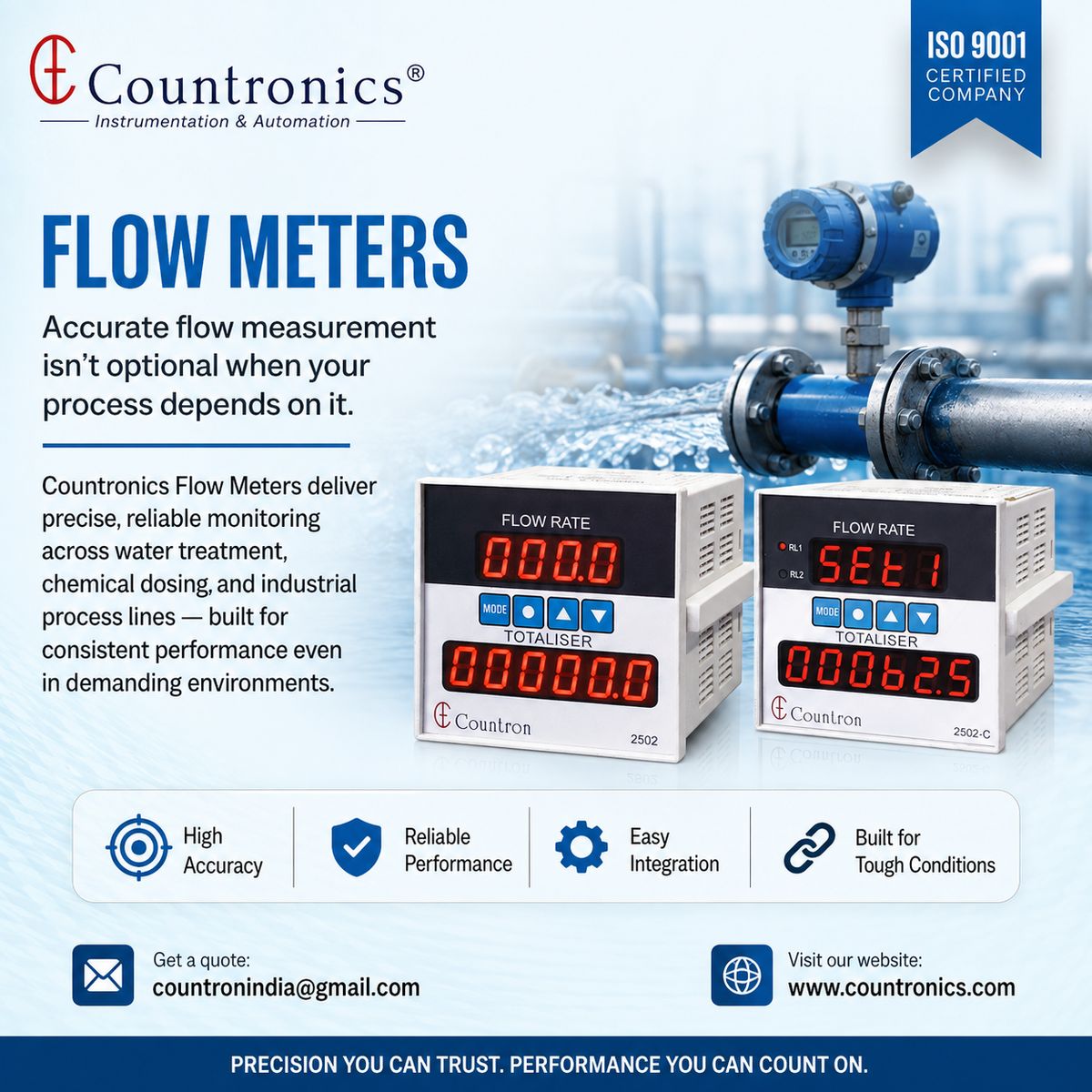
Countronics makes a Flow Rate Indicator & Totalizer that accepts pulse or 4–20 mA inputs, with programmable K-factor, selectable square-root function and a total that is saved through power cuts. Talk to us if your readings don’t add up.
By Countronics
By Countronics

By Countronics

© 2026 - Home Automation WordPress Theme. countronics.com
WhatsApp us
