
There’s no single right number. These are typical working ranges; always check the product label or supplier specification first.
| Stored goods | Typical temperature | Typical RH | What goes wrong outside range |
|---|---|---|---|
| General dry goods, FMCG | Below 30 °C | 40–60% | Cartons soften, labels lift, mould |
| Pharmaceuticals (room temp.) | As per label, often below 25 °C or 30 °C | Below 60–65% | Loss of potency, regulatory non-compliance |
| Pharmaceuticals (cold chain) | 2–8 °C | — | Vaccines and biologicals degrade |
| Electronics, PCBs, components | 15–30 °C | 30–60% | Moisture absorption, corrosion; static if too dry |
| Paper, packaging, labels | 18–25 °C | 40–55% | Curling, warping, printing problems |
| Food grains, spices | Cool, ventilated | Below 65% | Mould, insects, aflatoxin |
| Cement, fertiliser, chemicals | Ambient | As low as practical | Lumping, caking, reduced quality |
A single gauge near the office door tells you about the office door. Conditions inside a large shed can vary by several degrees and 15–20% RH from one corner to another. Place sensors at the worst points:
For regulated storage like pharma, a temperature mapping study (logging many points over a few days in summer and in the monsoon) is the standard way to find these hot and humid spots before deciding where permanent sensors go.
When warm, humid air touches a surface colder than its dew point, water condenses on it. In practice this shows up as:
The fix is rarely more cooling. It’s usually ventilation, dehumidification or insulation, and keeping an eye on humidity, not just temperature.
A reading nobody looks at doesn’t protect anything. If staff have to walk up to a small gauge, it gets checked once a shift at best. A large display that can be read from across the floor gets glanced at many times a day, and problems get noticed while they’re still small.
A common rule of thumb is about 10–12 metres of comfortable reading distance per inch of character height:
| Digit height | Comfortable reading distance | Good for |
|---|---|---|
| 0.56 inch | 5–7 m | Panels, small rooms |
| 1 inch | 10–12 m | Labs, small stores |
| 2.3 inch | 25–30 m | Production floors |
| 4 inch | 40–45 m | Large warehouses, halls |
It depends on what is stored. As a general guide, most dry goods, packaging and electronics are safest at about 40–60% RH. Above roughly 65% RH, mould, rust, caking and corrugated box softening become much more likely.
Not just near the office door. Place them at the hottest and most humid spots: under the roof sheets, near loading doors, along sun-facing walls and at different rack heights. A temperature mapping exercise shows where these spots are.
A common rule of thumb is about 10–12 metres of comfortable reading distance for every inch of character height. A 1-inch display suits a small room, while 4-inch digits can be read from around 40–45 metres across a hall.
When warm, humid air touches a surface colder than its dew point, water condenses. This happens on cold floors, metal roof sheets at night, and near cold-room doors, especially during the monsoon.
For general storage, at least twice a day at fixed times. For pharmaceuticals and other regulated goods, continuous recording with a data logger is now the norm, along with a documented response for any out-of-range reading.
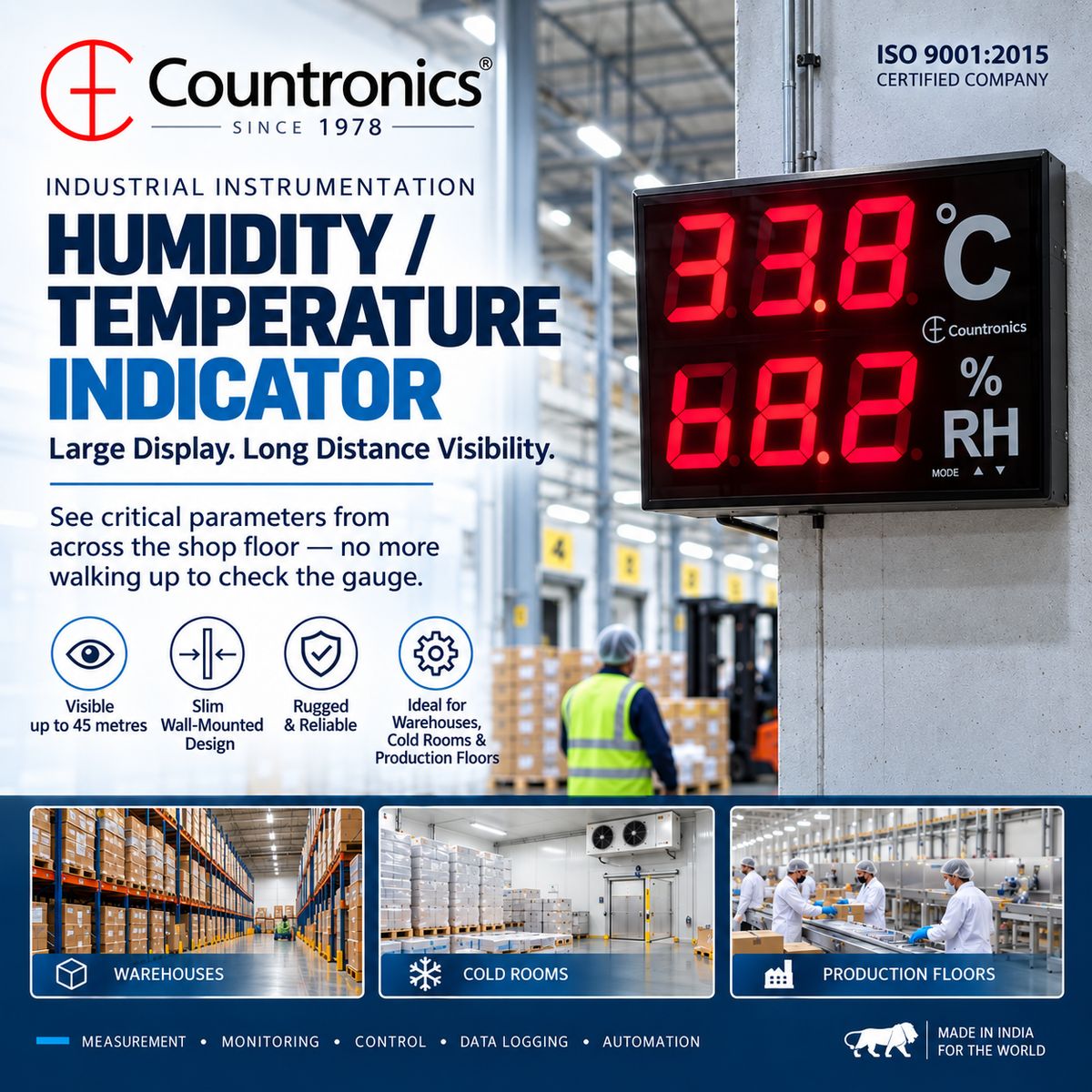
Countronics makes a 4-inch Humidity & Temperature Indicator readable from about 45 m, in a slim 55 mm wall-mounted cabinet. Talk to us if you want help deciding how many points to monitor and where.
By Countronics

By Countronics
By Countronics

© 2026 - Home Automation WordPress Theme. countronics.com
WhatsApp us
