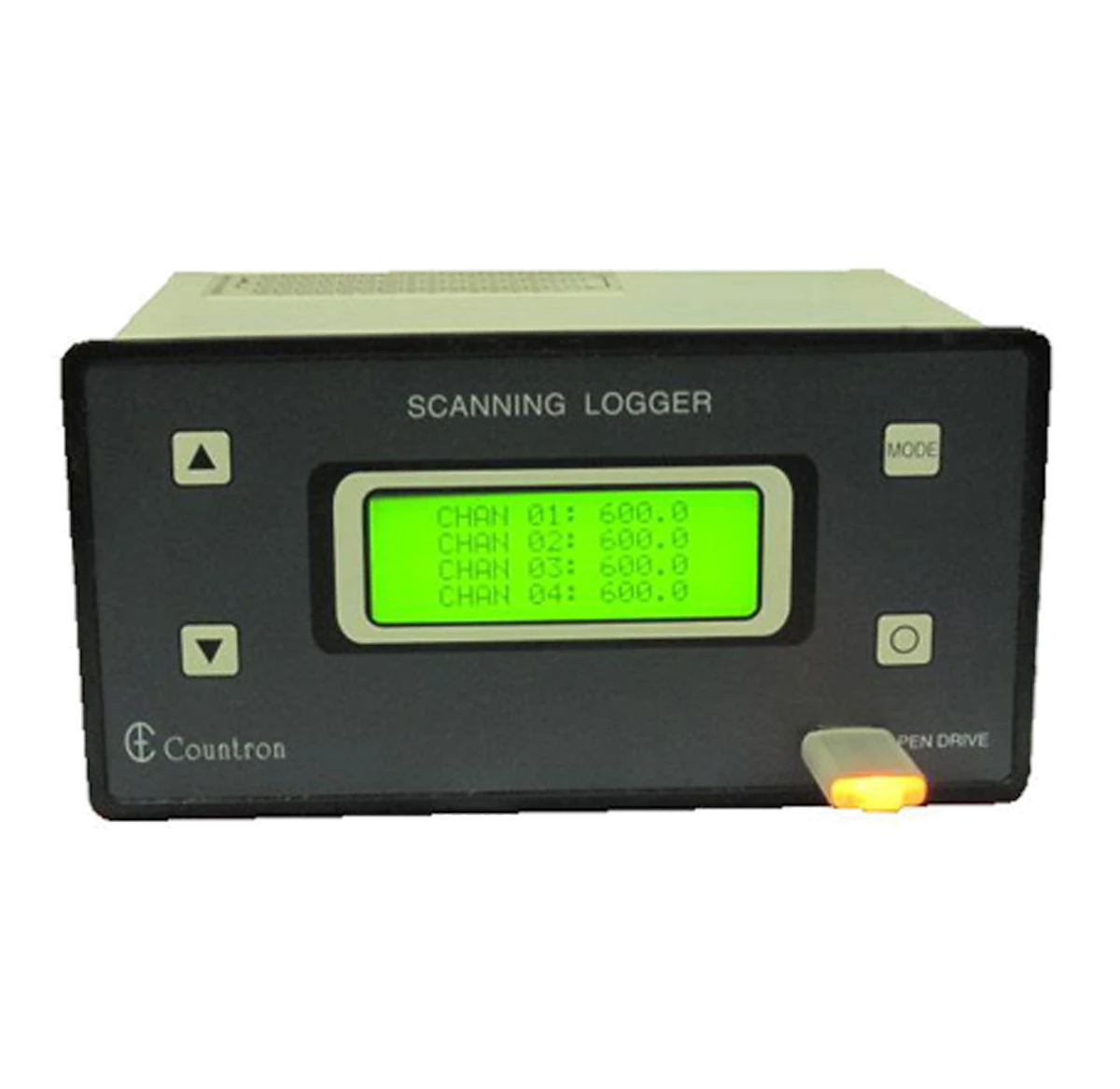

16 channel Universal Data Logger

Temperature Mapping Of Cold Rooms, Stability Chambers And Ovens: How Many Sensors, Where And For How Long

In short: Temperature mapping places many sensors through a space at the same time to find its hot and cold spots. Use a grid covering top, middle and bottom levels, corners and the centre, plus sensors near doors, coils and the controller probe. Log long enough to include normal cycles — commonly 24 hours to 7 days — and repeat with a full and empty load where it matters.

Why Map at All?

A controller probe shows the temperature at one point. Air stratifies, doors let warm air in, and evaporator coils create cold zones. Mapping shows how the whole space behaves, so products are stored only where conditions are acceptable and the monitoring probe is placed at a representative or worst-case point.

How Many Sensors?

SpaceTypical approach
Small chamber or incubator9 points: corners of top and bottom shelves plus centre
Walk-in cold room3 levels × grid of corners, centre and door area — often 15–30 points
WarehouseGrid every few metres at several heights, plus doors, roof and outside walls
Oven / autoclavePoints through the load and empty chamber, plus near heater and drain

A 16 channel logger covers most chambers and cold rooms in a single run; two can be used for larger spaces.

Where to Put the Sensors

  • Top, middle and bottom levels
  • All corners and the centre
  • Near the door and loading area
  • Near the evaporator, heater or air outlet
  • Next to the existing controller or monitoring probe
  • Inside product-sized dummy loads, if product temperature matters

How Long Should the Study Run?

Long enough to include every normal cycle — compressor on/off, defrost, day and night, working shifts and weekends. Short chambers are often mapped for 24–72 hours; warehouses for a week, sometimes in both summer and winter.

Tests Worth Adding

  • Door-open test: open the door for a typical time and record recovery.
  • Power-failure test: switch off and measure how long the space stays within limits.
  • Loaded vs empty: loads change airflow and recovery time.

Reporting the Results

For each sensor, report minimum, maximum and average, and highlight any time outside limits. Mark the hottest and coldest points on a drawing — these become the locations for permanent monitoring. A CSV file from a pen-drive logger makes these calculations easy in Excel.

Mistakes to Avoid

  1. Sensors taped to walls or shelves, measuring the surface instead of the air.
  2. Logging too briefly to catch a defrost or weekend.
  3. Sensors not checked against a reference before the study.
  4. No record of door openings during the test.

Quick Checklist

  • Sensor layout drawing
  • Sensors verified before and after
  • Clocks synchronised
  • Duration covers all cycles
  • Door-open and power-off tests
  • Hot/cold spots marked for permanent probes

Frequently Asked Questions

How many sensors are needed for temperature mapping?

It depends on the size of the space. Small chambers often use about 9 points; walk-in cold rooms commonly 15 to 30; warehouses use a grid at several heights.

How long should a temperature mapping study last?

Long enough to include all normal cycles such as defrost, shifts and weekends — typically 24 hours to 7 days.

Where should the permanent monitoring probe go after mapping?

At the worst-case or most representative point found in the study, often the warmest location for cold storage.

Can a multi-channel data logger be used for mapping?

Yes. A 16 channel logger records all points with the same time stamp, which makes comparison simple.

Should mapping be repeated?

Yes, after major changes to the space, equipment or layout, and periodically as required by your quality system.

Planning a Mapping Study?

Countronics makes multi-channel temperature data loggers with J/K/R and PT100 inputs that save to a USB pen drive. Tell us the size of your space and we will suggest a setup.


In short: Most thermocouple faults are wiring, not the sensor. Check in this order: right type selected in the instrument → polarity at every joint → same-type extension cable (no copper) → connections
Thermocouple Troubleshooting: Wrong Readings, Reversed Wires, Noise, Drift And Open Circuits
In short: A thermowell is a closed tube welded or screwed into a pipe or vessel so the temperature sensor can be removed without draining or depressurising the process. It protects the sensor
Thermowell Guide: When You Need One, Insertion Length, Response Time And Materials
In short: A PT100 is a platinum resistor that measures 100 Ω at 0 °C and rises by about 0.385 Ω per °C (138.5 Ω at 100 °C). The instrument passes a small
How Does A PT100 (RTD) Work? Resistance vs Temperature, 2-, 3- And 4-Wire Connections And Class A vs B