
At minimum, three things: temperature, relative humidity (RH) and differential pressure against the adjacent area. Particle counts and air changes matter too, but they’re usually checked periodically during qualification. Temperature, humidity and pressure can change within minutes, so they need watching continuously.
There’s no single number. It depends on the product and the process. As a working reference, these are the ranges most facilities use:
| Application | Typical Temperature | Typical RH | Why |
|---|---|---|---|
| Pharma oral solids (tablets, capsules) | 20–25 °C | 30–55% | Many powders and gelatin capsules absorb moisture; tablets stick, capsules soften or turn brittle |
| Pharma sterile / injectables | 18–22 °C | 45–55% | Operator comfort in full gowning, which reduces shedding and sweating |
| Electronics / PCB assembly | 20–24 °C | 40–60% | Below ~30–35% RH, static discharge risk rises sharply |
| Hospital operation theatre | 20–24 °C | 40–60% | Patient and staff comfort, infection control |
Your own limits should come from your product’s stability data and your validated HVAC design. Treat the table as a starting point, not a specification.
Most GMP guidelines, including EU GMP Annex 1 and WHO guidance, suggest a pressure differential of around 10–15 Pa between adjacent rooms of different cleanliness grades. The cleaner room is kept at the higher pressure, so air always flows out of the clean area, never in.
There’s one important exception. Rooms that handle potent drugs, hormones, cytotoxics or biohazards are often kept at negative pressure relative to the corridor. That keeps the product inside rather than keeping dust out. In these rooms, a reversed pressure reading is a safety issue, not just a quality one.
Outside air in much of India can stay above 80% RH for weeks. If the AHU’s cooling coil isn’t removing enough moisture, or the dehumidifier is undersized, room RH climbs. The temperature can look perfectly normal while this happens. Watching temperature alone hides the problem, which is why humidity needs its own reading and alarm.
Not quite. Opening a door causes a pressure dip lasting a few seconds. If the alarm fires on every door opening, staff learn to ignore it. A common practice is to allow a short delay, often 30–60 seconds, before alarming on pressure, while keeping temperature and humidity alarms on their normal response. The goal is an alarm people take seriously.
For GMP areas, continuous monitoring with automatic recording is now the expectation. Where manual records are still used, readings are typically logged at fixed times each shift. Any out-of-limit value needs a documented reason and corrective action, not just a tick.
At minimum, temperature, relative humidity and differential pressure against the adjacent area. Particle counts and air changes matter too, but they are usually checked periodically during qualification. Temperature, humidity and pressure can change within minutes, so they need continuous watching.
It depends on the product and process. As a working reference, pharma oral solids areas typically run at 20–25 °C and 30–55% RH, sterile areas at 18–22 °C and 45–55% RH, and electronics assembly at 20–24 °C and 40–60% RH. Your own limits should come from product stability data and your validated HVAC design.
Most GMP guidelines, including EU GMP Annex 1 and WHO guidance, suggest around 10–15 Pa between adjacent rooms of different cleanliness grades, with the cleaner room at higher pressure. Rooms handling potent drugs or biohazards are often kept at negative pressure so the product stays inside.
Not quite. Opening a door causes a pressure dip for a few seconds. A common practice is to allow a delay of about 30–60 seconds before alarming on pressure, so staff do not learn to ignore the alarm.
Most facilities recalibrate temperature, humidity and pressure sensors at least once a year. Humidity sensors in particular drift over time, and calibration certificates should be kept on file for audits.
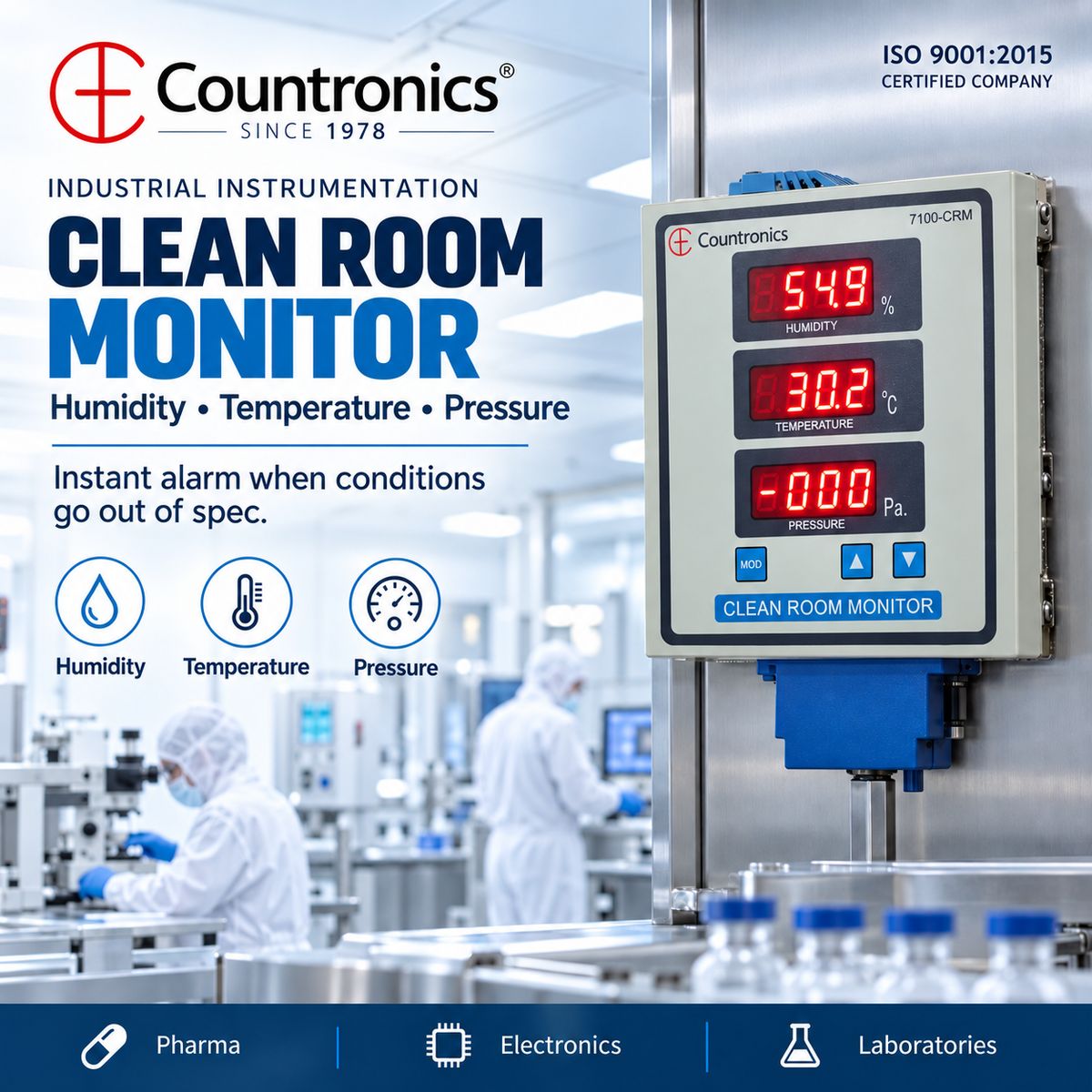
At Countronics we make a Clean Room Monitor that shows humidity, temperature and pressure on one panel at the room entrance, with a common alarm if any of them goes out of range. If you want help choosing ranges or sensor positions, talk to us.
By Countronics

By Countronics
By Countronics

© 2026 - Home Automation WordPress Theme. countronics.com
WhatsApp us
