

Countronics
Categories: Humidity Controller
📘 Part of the Temperature Measurement Knowledge Hub — guides on thermocouples, PT100, controllers and data logging.
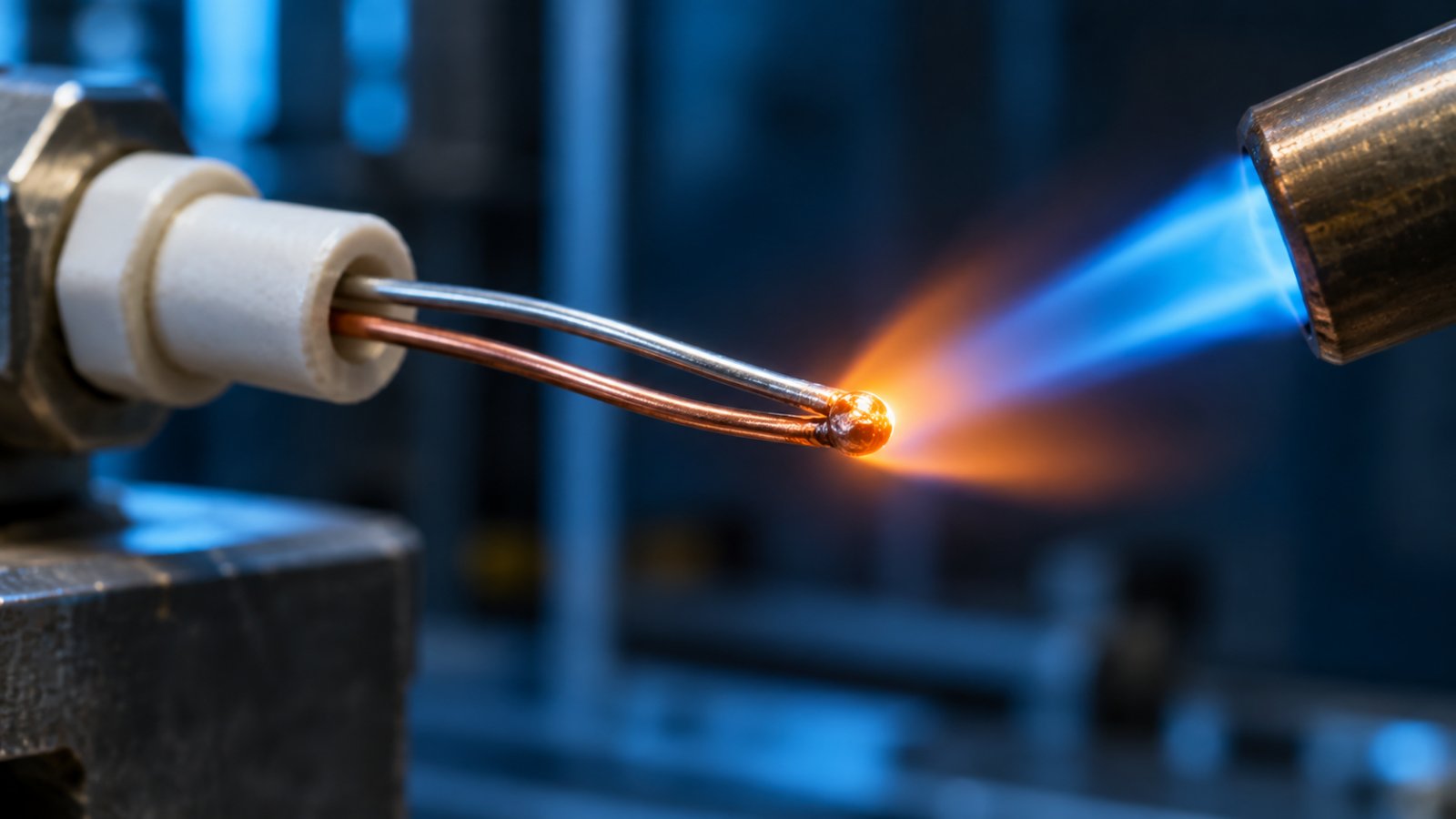
When a metal wire has one end hotter than the other, a small voltage develops along it. Different metals produce different voltages for the same temperature difference. Join two different metals at the hot end and measure between their free ends, and you see the difference between their voltages. That net voltage — a few millivolts — is the thermocouple signal.
A key point engineers often miss: the voltage is generated along the length of the wires where the temperature changes, not at the junction itself. This is why the whole circuit, including extension cable, matters.
| Type | Approx. sensitivity near room temperature | Output at 500 °C (ref. 0 °C) |
|---|---|---|
| J | about 52 µV/°C | about 27.4 mV |
| K | about 41 µV/°C | about 20.6 mV |
| T | about 41 µV/°C | (range ends at 400 °C) |
| E | about 61 µV/°C | about 37.0 mV |
| N | about 26 µV/°C | about 16.7 mV |
| S | about 6 µV/°C | about 4.2 mV |
The relationship is not perfectly linear, so instruments use standard reference tables (IEC 60584 / ASTM E230) or polynomials to convert millivolts to temperature. This is called linearisation.
The measured voltage represents the temperature difference between:
If the terminals are at 30 °C and the tip is at 500 °C, a Type K produces the voltage for a 470 °C difference. Without correction, the instrument would read about 30 °C low.
Modern instruments measure the terminal temperature with a sensor next to the input terminals, convert it to an equivalent thermocouple voltage, add it to the measured voltage, and then convert the total to temperature. Historically the cold junction was kept in an ice bath at exactly 0 °C — which is why the tables are referenced to 0 °C.
CJC only works if the thermocouple alloy reaches all the way to the terminals where CJC is measured. Every Countronics thermocouple input — in temperature controllers, indicators and multi-channel data loggers — has automatic cold junction compensation.
If you join a Type K sensor to ordinary copper cable in a junction box, a new cold junction is created at that box. The instrument compensates for its own terminals, not the box, so the reading is wrong by roughly the difference between the box and terminal temperatures — and it changes as the box heats up. Use extension or compensating cable of the same type and same colour code (see the thermocouple colour chart), with matching thermocouple connectors.
When two different metals are joined and a temperature difference exists along them, a small voltage is produced. A thermocouple measures this voltage to find temperature.
Because its voltage depends on the difference between the tip and the instrument terminals. CJC measures the terminal temperature and adds it back.
About 41 µV per °C near room temperature, or roughly 20.6 mV at 500 °C with a 0 °C reference.
No. Copper creates a new cold junction and causes errors. Use extension or compensating cable of the same type.
The polarity is probably reversed at a terminal or joint.
Countronics temperature controllers, indicators and data loggers accept J, K and R thermocouples with automatic cold junction compensation.
By Countronics
By Countronics

By Countronics
© 2026 - countronics.com
WhatsApp us