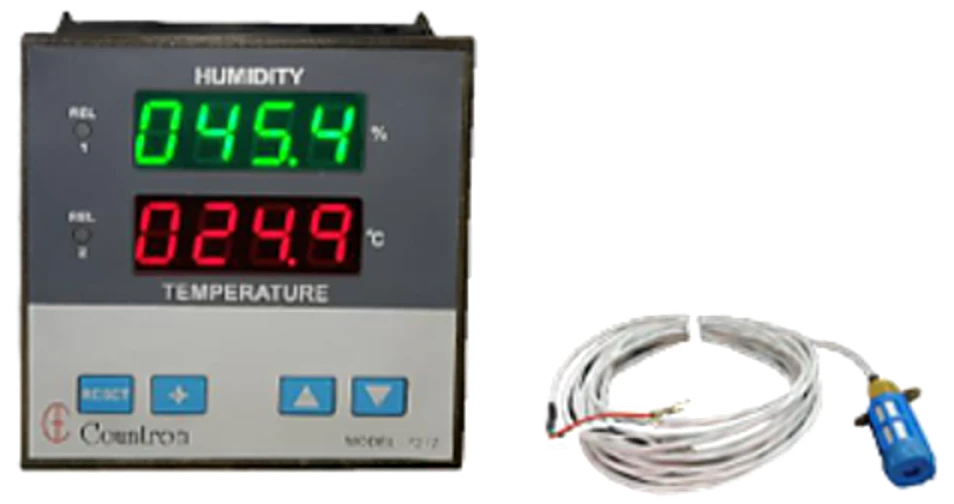


Countronics
Categories: Humidity Controller
| Instrument | What it does | Typical outputs | Use when |
|---|---|---|---|
| Humidity indicator | Displays RH (and usually temperature) | Sometimes an alarm relay or 4–20 mA | Operators need to see conditions |
| Humidity controller | Displays and switches equipment at set points | Relays for humidifier, dehumidifier, fans, alarm | Conditions must be held automatically |
| Humidity data logger | Records readings with time stamps | USB, network or cloud, reports | You need records for audits, customers or investigations |
| Controller with logging | Controls and records | Relays plus memory or communication | Controlled rooms that also need records |
Answer three questions:
| Situation | Suggested setup |
|---|---|
| Office, server corner, general awareness | Indicator |
| Textile or printing area with humidifiers | Controller |
| Pharma or food warehouse with storage limits | Multiple loggers plus alarm, controller where HVAC is local |
| Stability or test chamber | Controller plus independent logger |
| Seed store, cold room with dehumidifier | Controller with alarm, logger for records |
For regulated storage, a common practice is to keep the logger independent of the controller. If the controller’s sensor drifts, the logger still shows the true condition.
Write down the lowest and highest RH and temperature the instrument will see. Then read the accuracy at those conditions, not only at 25 °C and 50 % RH. For tight tolerances, aim for an instrument error no more than about a third of the tolerance.
One sensor tells you the condition at one point. Warehouses and large rooms can vary by several degrees and 10 % RH or more between a loading bay and a back corner. A short mapping study with several loggers over a week or more shows where the extremes are. Permanent sensors then go at those worst-case points.
See our guide on warehouse temperature and humidity monitoring for how this is done.
Related reading: how to read a humidity meter specification, how a humidity controller works and temperature and humidity data loggers.
An indicator only displays humidity, and sometimes temperature. A controller also has set points and relay outputs, so it can switch a humidifier, dehumidifier, fan or alarm automatically.
If you must prove conditions to an auditor, customer or regulator, yes, unless the controller itself records data. A controller keeps conditions in range; a logger keeps a time-stamped record that the conditions were in range.
Small rooms often need one at the working or storage height. Large warehouses need several, placed after a mapping study that finds the hot, cold, humid and dry spots. Racked stores usually need sensors at more than one height.
Choose a remote probe when the display or panel must be outside the measured space, such as a cold room, oven, chamber or duct. Choose wall-mount for normal rooms where the instrument can sit in the space itself.
Yes, if it has two relays with separate set points: one switching on the humidifier below the low limit and one switching on the dehumidifier above the high limit, with a neutral band between them.
Countronics makes humidity indicators, temperature and humidity controllers and humidity loggers. Tell us what you need to watch, control or record and we will suggest a fit.
By Countronics
By Countronics
By Countronics
© 2026 - countronics.com
WhatsApp us