

Countronics
Categories: Humidity Controller
⚡ More on ampere-hour meters: Countronics AH meter range · What is an Ah meter?
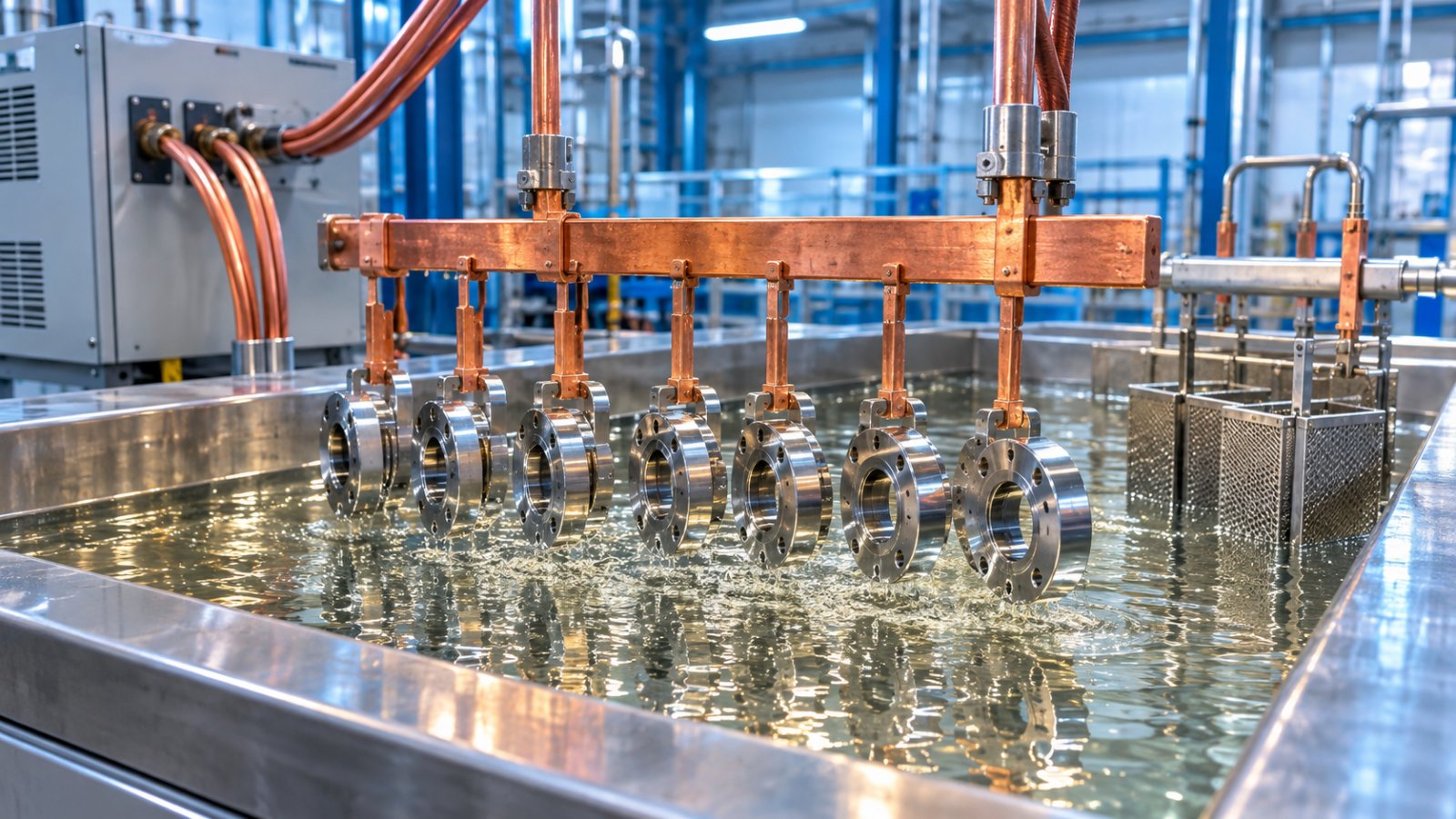
An electroplating tank is an electrolytic cell. A DC rectifier drives current through a solution (the electrolyte) containing dissolved metal ions:
Every atom deposited needs a fixed number of electrons, so the amount of metal depends only on how many electrons flowed — that is, on current × time, the charge.
Faraday’s law of electrolysis gives the mass deposited:
Mass (g) = (Ah × M × η) ÷ (n × 26.8)
where M is the metal’s atomic mass, n the electrons per ion, η the cathode current efficiency, and 26.8 Ah is the charge of one mole of electrons (Faraday’s constant). Dividing by density and area gives thickness:
| Metal (typical bath) | g per Ah (100 %) | µm per Ah/dm² (100 %) | Typical efficiency |
|---|---|---|---|
| Nickel (Watts) | 1.095 | 12.3 | 95–98 % |
| Copper (acid sulphate) | 1.186 | 13.2 | ~100 % |
| Zinc (acid or alkaline) | 1.220 | 17.1 | 60–95 % depending on bath |
| Chromium (hard chrome, Cr⁶⁺) | 0.323 | 4.5 | 15–25 % |
| Item | Value |
|---|---|
| Load area | 20 dm² |
| Target thickness | 10 µm |
| Ah per dm² = 10 ÷ (12.3 × 0.95) | 0.86 Ah/dm² |
| Total Ah = 0.86 × 20 | 17.1 Ah |
| At 40 A (2 A/dm²) | about 26 minutes |
Set the ampere-hour meter preset to 17.1 Ah and the batch ends when that charge has been delivered — whether the current stays at 40 A or sags to 35 A. For deeper calculation examples, see ampere-hour calculation for electroplating and battery testing.
| What changes | Effect on current | Timer result | Ah meter result |
|---|---|---|---|
| Loose or dirty rack contact | Current drops | Thinner deposit | Cycle extends automatically |
| Bath temperature rises | Current rises | Thicker, wasted metal | Stops at the same Ah |
| Smaller load area | Current per part changes | Inconsistent thickness | Ah scaled to area |
| Rectifier ripple or drift | Unstable current | Uncontrolled | Integrated exactly |
Countronics ampere-hour meters (800AH, 803AH, 804AH, 805AH) measure up to 9999 A with a 75 mV shunt, hold their count through power cuts, and have preset relays. The same principle applies to anodising — see anodising process control with an Ah meter.
It measures the actual charge passed and stops the rectifier at a set Ah, so plating thickness stays the same even if the current changes.
About 1.095 g per Ah at 100 % efficiency, or roughly 12.3 µm per Ah/dm²; real baths run at about 95–98 %.
The mass of metal deposited is proportional to the charge passed: mass = Ah × atomic mass × efficiency ÷ (electrons per ion × 26.8).
Chromium needs six electrons per ion and the bath efficiency is only about 15–25 %, so far more charge is needed per micron.
A DC shunt rated near your maximum tank current at 75 mV full scale.
No — each tank needs its own shunt and meter for accurate control.
Countronics makes ampere-hour meters with preset relays for electroplating, anodising and hard chrome. Share your tank current and target thickness and we will help you set them up.
By Countronics
By Countronics
By Countronics
© 2026 - countronics.com
WhatsApp us