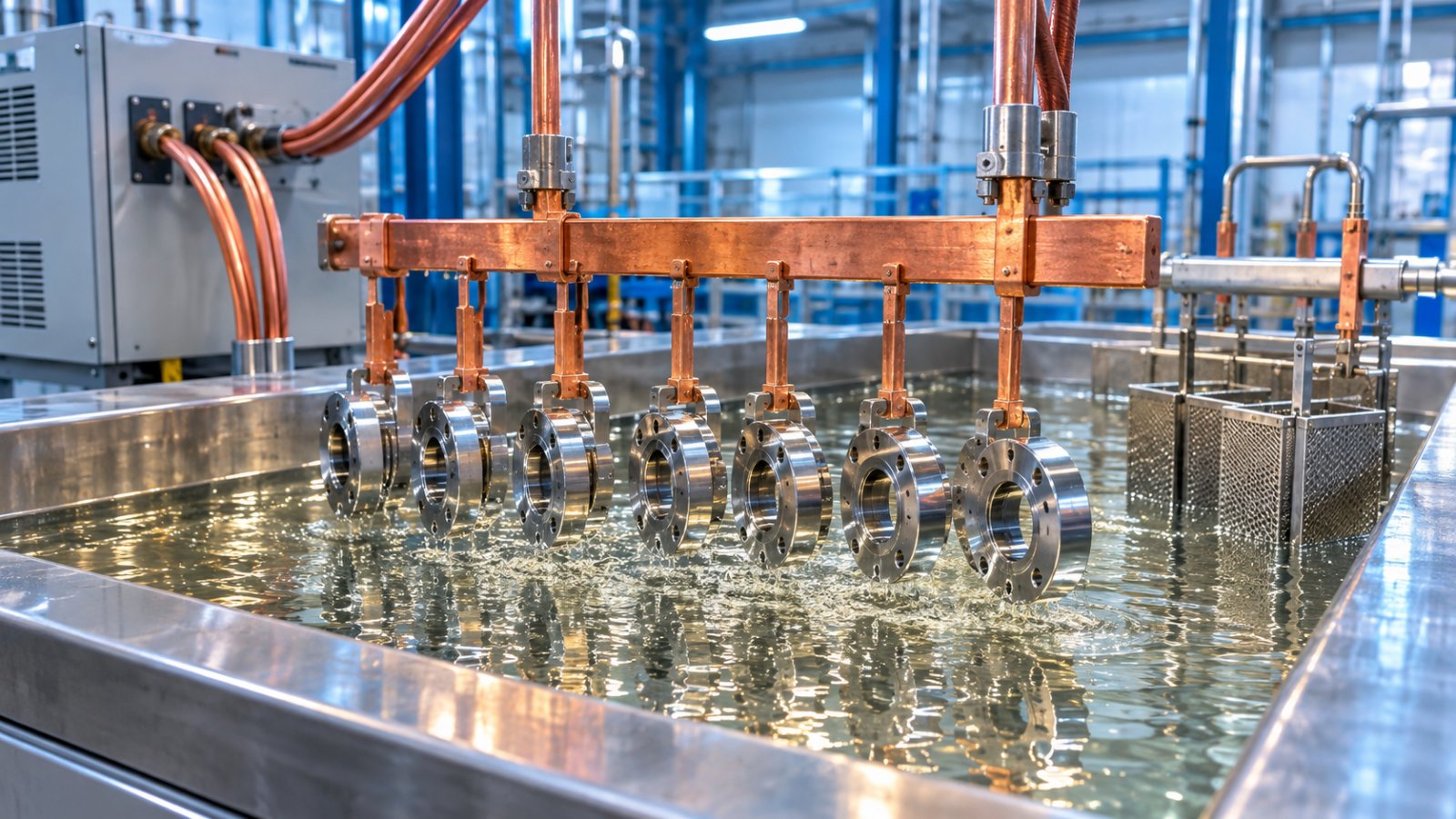

Parts on a plating rack entering a nickel electroplating tank

Precision Electroplating With An Ampere-Hour Meter: How Plating Works, Faraday’s Law And Why Charge Control Beats A Timer

In short: In electroplating, metal is deposited on the part in direct proportion to the electric charge passed — ampere-hours (Ah). At 100 % efficiency, 1 Ah per dm² deposits about 12.3 µm of nickel or 13.2 µm of copper. Because tank current drifts with contact resistance, bath temperature and load area, a fixed timer gives variable thickness; an ampere-hour meter that stops the rectifier at a set Ah gives the same deposit every batch.

⚡ More on ampere-hour meters: Countronics AH meter range · What is an Ah meter?

How Electroplating Works

An electroplating tank is an electrolytic cell. A DC rectifier drives current through a solution (the electrolyte) containing dissolved metal ions:

  • The part to be plated is the cathode (connected to the rectifier’s negative terminal).
  • The anode (positive) is usually the plating metal itself — nickel, copper or zinc — or an inert anode, as in chrome plating.
  • Positive metal ions in the solution move to the cathode, gain electrons and deposit as metal: for nickel, Ni²⁺ + 2e⁻ → Ni.
  • At a soluble anode, metal dissolves to replace the ions used, keeping the bath concentration steady.

Every atom deposited needs a fixed number of electrons, so the amount of metal depends only on how many electrons flowed — that is, on current × time, the charge.

Faraday’s Law: From Ampere-Hours to Microns

Faraday’s law of electrolysis gives the mass deposited:

Mass (g) = (Ah × M × η) ÷ (n × 26.8)

where M is the metal’s atomic mass, n the electrons per ion, η the cathode current efficiency, and 26.8 Ah is the charge of one mole of electrons (Faraday’s constant). Dividing by density and area gives thickness:

Metal (typical bath)g per Ah (100 %)µm per Ah/dm² (100 %)Typical efficiency
Nickel (Watts)1.09512.395–98 %
Copper (acid sulphate)1.18613.2~100 %
Zinc (acid or alkaline)1.22017.160–95 % depending on bath
Chromium (hard chrome, Cr⁶⁺)0.3234.515–25 %

Worked Example — Bright Nickel

ItemValue
Load area20 dm²
Target thickness10 µm
Ah per dm² = 10 ÷ (12.3 × 0.95)0.86 Ah/dm²
Total Ah = 0.86 × 2017.1 Ah
At 40 A (2 A/dm²)about 26 minutes

Set the ampere-hour meter preset to 17.1 Ah and the batch ends when that charge has been delivered — whether the current stays at 40 A or sags to 35 A. For deeper calculation examples, see ampere-hour calculation for electroplating and battery testing.

Why a Timer Is Not Enough

What changesEffect on currentTimer resultAh meter result
Loose or dirty rack contactCurrent dropsThinner depositCycle extends automatically
Bath temperature risesCurrent risesThicker, wasted metalStops at the same Ah
Smaller load areaCurrent per part changesInconsistent thicknessAh scaled to area
Rectifier ripple or driftUnstable currentUncontrolledIntegrated exactly

How an Ampere-Hour Meter Fits the Line

  1. A shunt (typically rated at 75 mV for full current) is placed in the rectifier’s DC output.
  2. The Ah meter reads the shunt voltage, shows live current, and integrates it into Ah (or A·min).
  3. At the preset, a relay switches off the rectifier or signals the operator; the meter resets for the next batch.
  4. A total register records Ah per bath — the basis for brightener and additive dosing and anode replenishment.

Countronics ampere-hour meters (800AH, 803AH, 804AH, 805AH) measure up to 9999 A with a 75 mV shunt, hold their count through power cuts, and have preset relays. The same principle applies to anodising — see anodising process control with an Ah meter.

Precision Tips

  • Calculate area for each part and rack — area error is the biggest source of thickness error.
  • Choose a shunt rated close to your maximum current for best resolution.
  • Check thickness on sample parts (XRF or coulometric gauge) and adjust the Ah per dm² factor for your bath’s real efficiency.
  • Keep one shunt and meter per tank.
  • Log Ah per batch for traceability — see ampere-hour logging.

Mistakes to Avoid

  1. Plating on time while rack contacts degrade.
  2. Using a shunt rated far above actual current.
  3. Ignoring cathode efficiency (especially zinc and chrome).
  4. Wrong area estimate for complex parts.

Quick Checklist

  • Area per load known
  • Target thickness and efficiency known
  • Ah preset calculated
  • Shunt sized to tank current
  • Thickness verified per shift

Frequently Asked Questions

How does an ampere-hour meter help in electroplating?

It measures the actual charge passed and stops the rectifier at a set Ah, so plating thickness stays the same even if the current changes.

How much nickel is deposited per ampere-hour?

About 1.095 g per Ah at 100 % efficiency, or roughly 12.3 µm per Ah/dm²; real baths run at about 95–98 %.

What is Faraday’s law in electroplating?

The mass of metal deposited is proportional to the charge passed: mass = Ah × atomic mass × efficiency ÷ (electrons per ion × 26.8).

Why is hard chrome plating so slow?

Chromium needs six electrons per ion and the bath efficiency is only about 15–25 %, so far more charge is needed per micron.

What shunt does an Ah meter need?

A DC shunt rated near your maximum tank current at 75 mV full scale.

Can one Ah meter control several tanks?

No — each tank needs its own shunt and meter for accurate control.

Planning Ah Control for Your Plating Line?

Countronics makes ampere-hour meters with preset relays for electroplating, anodising and hard chrome. Share your tank current and target thickness and we will help you set them up.


In short: A battery’s capacity is the ampere-hours it can deliver before reaching its cut-off voltage. A rectifier charger converts AC mains to controlled DC and charges in constant-current then constant-voltage stages; a
Battery Charge And Discharge Testing: How A Rectifier Charger Works, Discharging Through A Load And Measuring Capacity With An Ah Meter
In short: In electroplating, metal is deposited on the part in direct proportion to the electric charge passed — ampere-hours (Ah). At 100 % efficiency, 1 Ah per dm² deposits about 12.3 µm
Precision Electroplating With An Ampere-Hour Meter: How Plating Works, Faraday’s Law And Why Charge Control Beats A Timer
In short: Most thermocouple faults are wiring, not the sensor. Check in this order: right type selected in the instrument → polarity at every joint → same-type extension cable (no copper) → connections
Thermocouple Troubleshooting: Wrong Readings, Reversed Wires, Noise, Drift And Open Circuits