

Countronics
Categories: PH Controller
A combination pH electrode has two halves in one body:
Almost every electrode choice is about protecting one of these three: the glass from attack, the reference from poisoning, and the junction from clogging.
In a single junction electrode the sample is separated from the Ag/AgCl reference by one junction. Some substances that seep in react with the silver, form deposits and block the junction. The reading then drifts and responds slowly.
A double junction electrode adds a second electrolyte chamber between the sample and the reference element. The contaminant has to cross two barriers, which protects the reference for much longer.
| Sample contains | Problem | Recommended |
|---|---|---|
| Clean water, drinking water, RO reject | None in particular | Single junction |
| Sulphides (tannery, refinery, sewage) | Silver sulphide blackens junction | Double junction |
| Proteins (dairy, food, pharma) | Proteins precipitate with silver | Double junction, open or sleeve junction |
| Heavy metals, plating rinses | Metal ions poison the reference | Double junction |
| Tris buffer, biological media | Reacts with silver | Double junction |
| Oily or high-solids effluent | Junction coats and clogs | Double junction with large-area PTFE or open junction |
| Type | Advantages | Limitations | Good for |
|---|---|---|---|
| Gel-filled (sealed) | No maintenance, robust, low cost | Shorter life, slower response in low-ionic water | Water treatment, general process use |
| Liquid refillable | Faster, more accurate, junction can be flushed, longer life | Needs electrolyte top-up | Labs, low-conductivity water, dirty samples |
| Solid or polymer reference | Very resistant to clogging and pressure | Slightly slower response | Effluent, slurries, high-pressure lines |
For very pure water such as boiler feed water or RO permeate (conductivity below about 50 µS/cm), standard gel electrodes respond slowly and drift. Use an electrode designed for low-ionic-strength water, usually with a flowing liquid junction.
| Glass type | Typical range | Use |
|---|---|---|
| General purpose | pH 0–12, 0–80 °C | Most water and process applications |
| High-pH (low sodium error) | pH up to 14 | Caustic solutions, CIP, textile dyeing, alkaline baths |
| High-temperature | up to about 100–130 °C (model dependent) | Hot process streams, sterilisable fermenters |
| Low-resistance (cold use) | 0–60 °C | Cold samples, refrigerated processes |
| HF-resistant or antimony | Varies | Samples containing fluoride or hydrofluoric acid |
Sodium error: in strong alkali with high sodium, general-purpose glass responds to sodium ions as well as hydrogen ions and reads low. A caustic wash at true pH 13 may read 12.5 on the wrong electrode. High-pH glass keeps this error small.
Temperature: every 10 °C rise roughly halves electrode life. An electrode that lasts a year at 25 °C may last only a few months in water at 70 °C.
| Mounting | Where used | Points to check |
|---|---|---|
| Dip or immersion | Open tanks, sumps, channels | Holder length, protection from floating debris |
| Inline (flow-through) | Pipelines, sample lines | Pressure rating, flow velocity, bubbles at the tip |
| Retractable | Lines that cannot be stopped | Allows removal for cleaning without shutdown |
| Hand-held | Spot checks, lab, field | Cable length, rinse between samples |
Mount inline electrodes at least 15° above horizontal so the internal air bubble stays away from the glass bulb, and never at the top of a pipe where air collects.
A two-point calibration gives two numbers that tell you the electrode’s health:
| Check | Good | Acceptable | Replace |
|---|---|---|---|
| Slope (% of theoretical 59.16 mV/pH at 25 °C) | 95 – 102 % | 92 – 95 % | below about 90 % |
| Offset at pH 7 | within ±15 mV | ±15 to ±30 mV | beyond ±30 mV |
| Response time in buffer | under 30 s | 30 – 60 s | over 60 s after cleaning |
Worked example: an electrode reads −4 mV in pH 7 buffer and +162 mV in pH 4 buffer at 25 °C. The change is 166 mV over 3 pH units, or 55.3 mV/pH. Slope = 55.3 ÷ 59.16 = 93.5 %, offset −4 mV. It is still usable, but trending down. Clean it and recheck in a week.
Read more on how pH is measured and calibrated, and see where electrodes face the toughest conditions in effluent and sewage treatment and industrial pH control.
Use a double junction electrode when the sample contains sulphides, proteins, heavy metals, Tris buffer or other substances that react with silver. The extra chamber keeps them away from the Ag/AgCl reference, so the junction does not blacken and clog.
Typically 6 to 18 months in process use, and longer in clean water at room temperature. High temperature, strong alkali, abrasive solids and drying out shorten life significantly.
Check the calibration report. Replace when the slope falls below about 90 to 92 percent, the offset at pH 7 moves beyond roughly ±30 mV, or the response takes more than a minute to settle after cleaning.
No. Distilled water slowly draws ions out of the glass and the reference. Store the electrode in a storage solution, usually 3M KCl, or in pH 4 buffer if storage solution is not available.
At high pH, usually above 12, sodium ions start to affect general-purpose glass, so the electrode reads lower than the true pH. Low-sodium-error (high-pH) glass reduces this and should be used for caustic solutions.
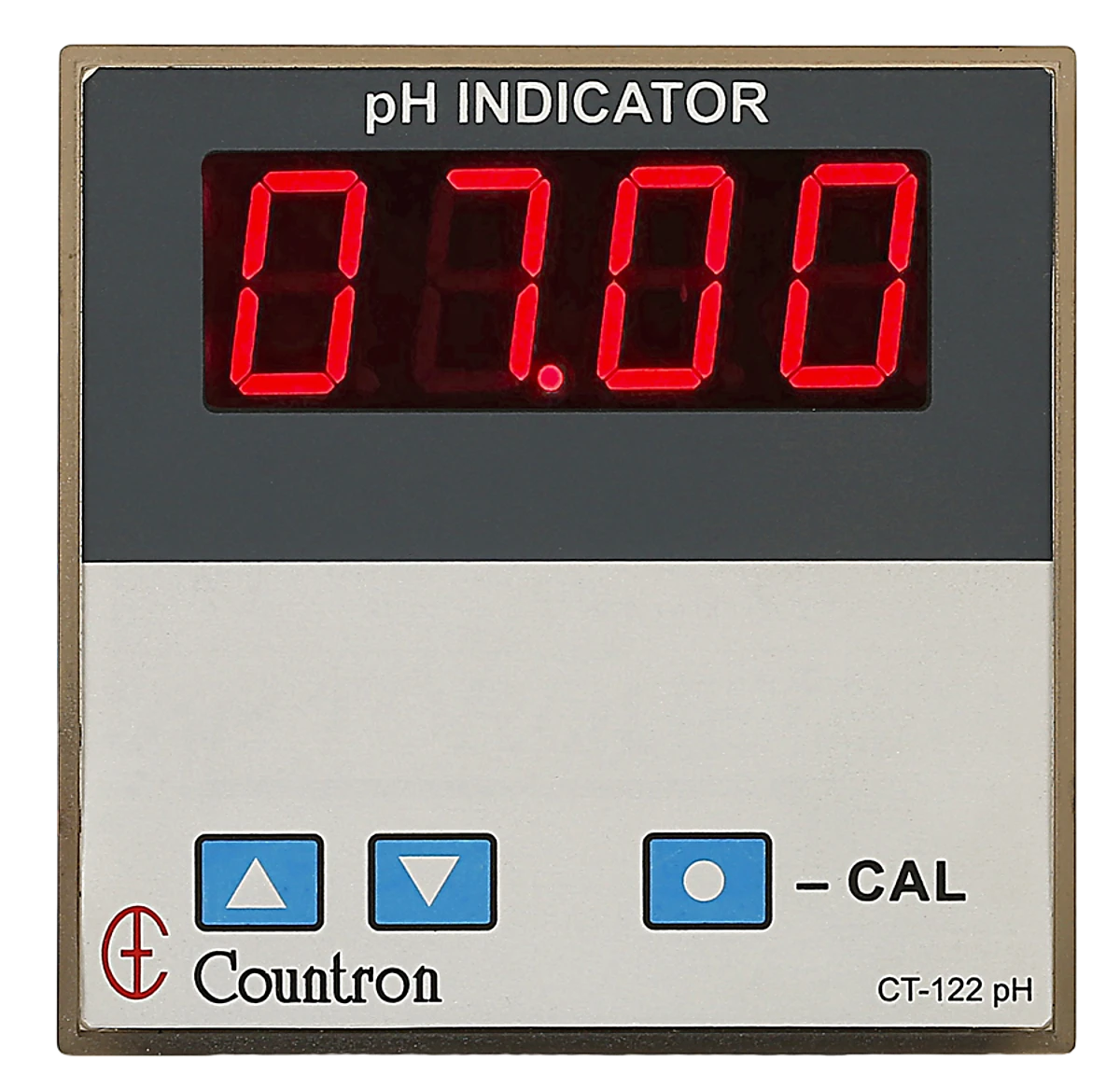
Countronics supplies pH indicators and controllers with matching electrodes for water, effluent and process use. Tell us your sample, temperature and mounting and we will recommend a suitable electrode.
By Countronics
By Countronics
By Countronics
© 2026 - countronics.com
WhatsApp us